A blog for better streets and public spaces in Portland, Maine.
Showing posts with label socialized parking. Show all posts

Thursday, February 21, 2019

Why is Portland wasting affordable housing funds on empty parking lots?

Last night the city of Portland declared a parking ban in advance of a snowstorm, which means that everyone had to move their cars into off-street parking lots.

And here's what the 22-space parking lot at Avesta Housing's Bayside East building (a low-income housing complex for seniors) looked like:

There were two more cars parked in the handicap spaces outside of the shot, but still, this is what I'm talking about when I kvetch about the wastefulness of Portland's and MaineHousing's parking requirements.

This parking lot was paid for in part from Maine's Low Income Housing Tax Credits, which are a) extremely limited and b) intended to subsidize affordable housing, not to subsidize our most unaffordable form of transportation.

Building this parking lot forced Avesta to set aside more than half of its 1/3rd acre parcel (adding ~$150,000 in land costs to the project) for pavement instead of for housing. What is today a 20-unit apartment building could have housed *twice* as many low-income households if the city and MaineHousing had not forced them to waste this real estate.

And, on an ongoing basis, this parking lot also forces Avesta Housing, a nonprofit agency, to spend thousands of dollars every year plowing, sanding, patching potholes and paying stormwater fees for an ugly field of asphalt that, as it turns out, their tenants don't want even when it's being given away for free!

Over the years, Portland's affordable housing developers have pissed away millions of dollars' worth of our state's limited low-income housing funds to build parking lots and garages like this one. Imagine how great our bus system could be if that money had been spent on METRO improvements instead.

Maine has over 30,000 renter households that don't own any cars, and Portland is one of the few places in the entire state where those families can live well without an automobile.

It's plainly wrong to mandate that a parking lot is the best way to solve low-income renters' mobility needs. Given the extortionist terms of subprime auto loans and the high costs of car maintenance, expecting low-income tenants to bring their own cars instead of helping them pay for transit passes is borderline sadistic. These families need apartments and better transit service much more than they need free parking, and Portland, as a city, needs planning laws and low-income housing financing rules that recognize this fact.

Thursday, September 13, 2012

"Maritime Landing" update

The "Maritime Landing" proposal for Bayside (first discussed on this blog a full year ago) is moving one step closer towards approval, as the City Council seems finally ready to endorse a purchase and sale agreement with the developers that would transfer them the city-owned land and grant them $9 million in funds to construct a 700-space parking garage. 

You can probably guess how I feel about the city's spending $9 million for a urine-soaked garage. In this case, though, I'll hold my nose (perhaps literally) because the developers are proposing to build a lot of housing to go along with it, plus active retail space on the garage's first floor. Last summer, when negotiations were beginning, they'd been proposing 540 apartments; now, they're talking up to 700 apartments (one previously-proposed office tower in the project has been replaced by another residential building) plus large ground-floor retail spaces that stretch the length of Somerset Street and also face the Bayside Trail. 

Here's a rough sketch that they brought to last night's committee meeting. After the Council approves the land sale agreement, the developers will have up to 3 years to construct the first phase of the project (the two towers on the left, plus the parking garage), the tax revenue from which will supposedly repay the city's loan for the parking garage. Sometime after the sale is finalized, the developers will come back to the city's planning board for a more detailed review of the project, including site design and architectural details.

Hopefully it works out better than the Ocean Gateway Garage project, which was also supposed to come with a lot of housing (five years after that eyesore got built with millions of dollars in city funds, it's still just a massive, half-empty parking garage on the waterfront, blighting the neighborhood with its ugliness). It deserves a note of caution that this project's parking garage plans and subsidies, much like the failed Ocean Gateway project, came from a pre-bubble era. And they specifically came from the minds of old-line, 1960s-urban-renewal bureaucrats like Joe Gray and Jack Lufkin, who embraced the anti-urban mentality that new construction in Portland required as much parking as you'd find at the Maine Mall.*

Another concern of mine relates to the project's general urban design. I have a feeling that the buildings are going to be cheap — both in terms of rent, and in terms of materials. The commercial brokers in charge of leasing the large retail spaces seem to be going after boring chains — I'll be astounded if CVS or Rite Aid don't lay claim to a big chunk of the project's retail space. 

Inexpensive, unimaginative urban development is actually good from the perspective of affordability — the city needs a lot more housing for the middle class, and the new residents will need boring places like CVS to take care of basic household needs. But I also worry about Bayside becoming like Boston, full of soulless chain stores and apartment towers with no sense of community.


But those devils will be worked out in the details. For now, it's good to see someone so bullish on Bayside, and Portland.


*This idea, that we needed lots of parking to compete with the suburbs, is typical of these older 1960s-era bureaucrats with low esteem for their city. In the years since these guys have left their posts in City Hall, the Maine Mall's owners, General Growth Properties, have gone into default. In a 2010 article about his parking garage's failures, Lufkin (who had by then been ousted from his city post) still asserted that "the lack of parking is among the biggest obstacles to development in Portland." And yet, in the five years since that garage was built, the number of cars registered in Portland has actually declined by over 6,000, and counting. That's enough cars to fill the Ocean Gateway garage eight times over. Lufkin now works for Gorham Savings Bank, so if you're a depositor there, he's your problem now.

Saturday, April 21, 2012

The Free Market Has Spoken: Rich People Don't Need That Much Parking (So Why Are We Still Forcing It on the Poor?)

The Bay House condominium project planned for the old Village Cafe lot in the India Street neighborhood has languished for over five years now.

In 2009, after the housing crash, the developers revised their project to add more parking spaces to a ground-level garage, to offer two parking spaces for every apartment in the complex. The additional parking made the building proposal much uglier and much more expensive, but the developers believed, at the time, that the extra parking spots would lure wealthy buyers.

Turns out, they were wrong. The extra parking added expense to the project, without adding much value. In the three years since then, Portland's housing shortage has gotten worse, with skyrocketing rents. The new condominiums on the top floor of the Hampton Inn building across India Street sold out within months, without an on-site parking garage. 
 
Now, the Bay House developers are going back before the Planning Board to request changes to their approval to make the building more cost-effective — and buildable. While the 2009 plan called for 159 parking spaces for 82 condos (or 1.92 parking spots for every unit), the 2012 plan calls for only 80 on-site parking spaces for 94 condos (0.85 parking spaces for every unit), with an arrangement to lease parking spaces in the half-empty, city-subsidized Ocean Gateway garage down the street, if necessary.

The laws of supply and demand in the free market for "luxury" housing have spoken: you can't sell new apartments with two expensive parking spaces and expect people (even rich people) to pay the price to justify the huge additional construction costs.

By requesting to build less parking, the developers are spelling it out for Portland planners that there is a demand for in-town housing, but there is a lot less demand for in-town parking. They're saying that they can sell expensive apartments, on the free market, to normal, able adults, at a profit to boot, even though not every one of those condos will have its own parking spot.

However. Portland's zoning codes still generally require developers to build at least one parking spot per dwelling unit on the peninsula; and TWO parking spots per unit off the peninsula, without regard to the laws of supply and demand.

What's especially ironic is that these rules apply disproportionately to developers of "affordable" housing — where even fewer residents own cars. Portland's Planning Board, and MaineHousing, still ask developers of subsidized housing to build at least one parking spot per dwelling unit for putatively "low-income" apartments — apartments for the POOR and DESTITUTE.

A luxury project like the Bay House, for people who can very easily afford to own a car, on the other hand, doesn't receive as many subsidies, has fewer bureaucratic strings attached, and therefore needs to waste less money and real estate on automobile storage areas.

If you still can't see how fucked up this is (don't worry, you have good company in City Hall and Augusta and on the Portland Planning Board), let me spell it out for you with some very basic logic:
  1. Real estate set aside for parking can not be used for housing. 
  2. Money spent on parking garages can not be spent on bedrooms.   
  3. Poor households don't own as many cars as rich households.
  4. Point (3) implies that low-income housing therefore needs fewer parking spaces per unit than high-income housing like the Bay House.
  5. Points (1), (2), and (4) imply that current city and state requirements that force nonprofit affordable housing developers to build as much or more parking than a luxury project like the Bay House are a waste of scarce financial resources, and needlessly deny needed housing to some of Portland's most vulnerable households.
  6. Corollary: any city planners who still can't grasp the five points above need mull it over overnight while lying on a disinfectant-soaked mattress on the crowded floor of the motherfucking Oxford Street homeless shelter. 

Tuesday, June 21, 2011

City Councilor Donoghue: "It's Too Hard to Stop Subsidizing City Hall Parking"

Last week, City Hall launched its new TDM2Go.com website, designed to help employers in Portland reduce their parking and payroll costs by getting more employees to work without cars.


It's a great effort, but there's some irony in it, as the Forecaster notes in its news report on the event: "Do as Portland City Hall says, not as it does."

You see, as much City Hall says it wants to encourage more downtown workers to walk, bike, or use transit, it still pays for free parking for every City Hall employee in the publicly-owned Chestnut Street parking garage. Given the "market" rate (I use that term loosely , as the "market" is itself tremendously distorted by other city policies) that's a subsidy of roughly $1,000 per employee every year.

This is, of course, a silly waste of public funds. But it's not as silly as City Councilor Kevin Donoghue's excuse for it: "Staff resources have not been allocated to implement this city policy," said Donoghue, who leads the City Council's Transportation Committee.

You might wonder, as I did, what kind of "staff resources" it takes to kill an ill-conceived subsidy. Wouldn't asking city employees to take personal responsibility for their own motor vehicles during the workday be a lot easier than asking the city bureaucracy to take care of them instead? Isn't this something that hundreds of downtown employees already do without any "staff resources"? Didn't we just go through a labor-intensive budget-cutting process, and wouldn't saving thousands of dollars in parking expenses make things considerably easier the next time around? For that matter, if "staff resources" are really a problem, wouldn't the money that City Hall saves from eliminating its parking subsidies be enough to hire a new full-time city employee?

Forget lightbulbs - how many City Councilors does it take to stop micromanaging the vehicular storage of city employees' personal automobiles?

To be fair to Kevin, whose heart is in the right place, this was a stupid quote made in the flush of embarrassment at being called out for hypocrisy by a news reporter. His natural first impulse was to make lame excuses.

If he'd like to redeem himself, his second impulse should be to make some changes.

Real leaders take charge and get things done without waiting for "staff resources" to do it for them. If real leadership exists on our current City Council, then we shouldn't have to wait until November for City Hall's parking subsidies to die.

The City Council could easily make the changes necessary by directing the city's parking manager to charge market rates for all users - whether or not they work for the city - at the city's publicly-owned garages.

This should not be a hard thing to do. I'd venture to say it might even be easier than changing a lightbulb.


Wednesday, January 26, 2011

Infill

For the past few weeks, I've been walking past a new triple-decker under construction on Cumberland Avenue, on the western slope of Munjoy Hill, designed by Kaplan Thompson Architects.


Today I learned that it's aspiring towards "Passive House" energy efficiency standards: "no fossil fuels will be needed for electricity, a/c or heating," according to the developers' facebook page, and it's being built "at a cost comparable to a traditional building." [edit - I've since learned that, although the building is borrowing some "passive house" concepts, it won't be certified under the strict Passive House standards.]

There's a lot more to like about this building, though: it's being built in the heart of the city, within easy walking distance of neighborhood groceries, downtown offices, and bus lines. It takes advantage of the city's newly-reduced parking requirements for downtown housing (more on that below, though). It fits in well with its neighborhood, as a modern update to the familiar triple-decker style. And it will bring in three more households to the neighborhood - which means more customers for local businesses, more eyes on the street looking out for their neighbors, and three fewer ranch houses chomping up forest and farmland in the suburbs.

In the past few years, City Hall has loosened its regulations considerably to make this kind of development possible. In the 1990s, for instance, this building would have been illegal: Portland's zoning code actually required developers to build ranch-style houses with suburb-sized front lawns in neighborhoods like Munjoy Hill (there'a a bizarre relic of this era on Atlantic Street). In 2008, the City reduced its residential parking requirements so that new housing wouldn't be required to dedicate more space to cars than to humans. This building takes advantage of that revision - the old zoning code would have required 2 parking spots for each unit, which wouldn't have left any room on the small lot for an actual building.

This project still sets aside space for 3 cars - which is far more parking than Portland's historic triple-decker buildings provide. In such a centralized location, it's highly probable that some potential buyers won't need a parking spot at all. But because the builders were forced to provide them, two things will happen: first, the building as a whole will be more expensive to build, and less affordable for buyers. And second, the homebuyers who are interested are more likely to own cars (since parking is included), which means that the neighborhood will have more car traffic than it otherwise would.

The developers will also lose potential customers (the ones who don't own cars and aren't willing to pay extra for a parking space they don't need), which means that building this building, and others like it, will be more financially risky.

So while Portland's parking requirements are less stupid than they used to be, the fact that we still have them at all means that City Hall is still mandating less affordable housing, less development, fewer customers for local businesses, and more traffic - contrary to all of our city's stated goals.

Monday, August 23, 2010

Parking is for losers (and the East End is losing)


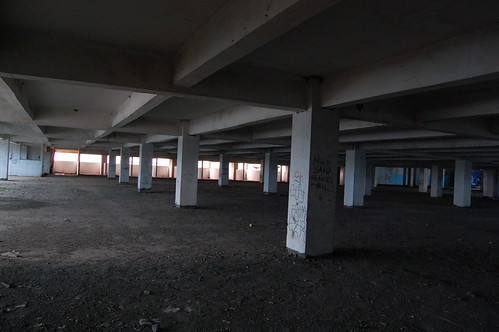
Abandoned parking lot, by Ikhlasul Amal.


Bell interviewed two business owners whose shops and restaurants neighbor the proposed garage, which is being developed under questionable financial assumptions by Opechee Construction of New Hampshire.

Both business owners rejected the conventional wisdom that more parking is good for economic development. "Nobody wants to walk around in a neighborhood full of parking lots," said Samantha Lindgren, co-owner of Rabelais. "It's discouraging," agrees Nancy Pugh, co-owner of Duckfat and Hugo's, two of Portland's more successful restaurants.

Bell also reveals that the City is paying $64,000 a year to subsidize a half-empty high-rise parking garage right across the street. That's because the City's former Economic Development Director, Jack Lufkin, agreed to guaranteed lease payments to help finance that garage at the peak of the real estate bubble.

View Downtown Portland Parking Lots in a larger map

Map showing the proposed new parking garage (center), across India Street from the new, city-subsidized Ocean Gateway Garage (center right), and other neighborhood parking lots and garages in red.

Amazingly, Lufkin stands by that deal to this day, claiming that "the lack of parking is among the biggest obstacles to development in Portland."

This is pure bullshit. There are numerous factors that are keeping developers from raising new buildings downtown. The most fundamental hurdle is the lack of potential tenants willing to pay rents that would be necessary to finance new construction.

Of course, this problem is closely related to the high cost of construction and land in downtown Portland, which are both artificially inflated due to City Hall's minimum parking requirements. The fact that so much real estate in downtown Portland is already occupied by parking lots makes the remaining land more expensive to buy and build on.

In other words, it's not the lack of parking that's impeding development; it's the fact that our city already wastes way too much real estate and money on parking quotas and subsidies.

But don't take my word for it. In 1998, Philadelphia Federal Reserve Bank economist Richard Voith pointed out that downtown areas have a competitive advantage in their walkable neighborhoods and cultural amenities. Building lots of cheap parking, he argued, "is unlikely to dramatically improve a downtown’s competitive position because the suburbs have a comparative advantage in land uses that demand a lot of space, such as parking lots and roads."

In other words, don't destroy an emerging urban neighborhood like the one around India Street by trying to make it compete with a strip mall hellhole like the one just over the bridge in Falmouth Foreside (where, for the record, an abundance of cheap parking has not rescued the town from a blight of abandoned box stores).

Lufkin was laid off in 2007 and now works for Gorham Savings Drive-Thru Bank, where he's probably bullying small business borrowers into sinking their limited capital into more asphalt instead of in their payrolls, equipment, or actual growth.

But wait! Here's one other out-of-towner who thinks that giving over half of the neighborhood to parking garages is a good idea:
When it comes to attracting development, there's no such thing as too much parking, said Nicholas Iselin, director of development and construction for Intercontinental Real Estate Corp., which owns the garage today."
Sure, if I were getting a $64,000 check every year from city taxpayers for an empty parking garage, I might feel the same way. Why not tear down the entire neighborhood for taxpayer-subsidized parking garages?

Back in the real world, it's hard to see how this new garage is going to make any financial sense for Opechee, the developers, when the city can't even give the stuff away right across the street.

Of course, they haven't started construction yet, so they and their financial lenders still have some time to come to their senses...

Friday, August 6, 2010

Can we do this here?

One of the Peninsula Transit Study's recommendations was for the city to adjust parking rates according to the time of day. San Francisco is about to try doing this on a broad scale, and the city's put together a good overview of how it would work:

SFpark Overview from SFpark on Vimeo.

Aside from making it easier for drivers to find a space on every block, and decreasing congestion, the bigger benefit from this program should be a more efficient allocation of scarce urban space. Drivers will spend less time searching for parking, and more time at the meter, generating more revenue for the city. And businesses will enjoy increased patronage from more customers.

In the longer term, data on parking rates and utilization in different neighborhoods will give planners and developers a better idea of how much new parking should be added with new development, instead of relying on arbitrary zoning codes that were developed in the 1960s. That would lead to lower costs of renting housing and office space in the city.

Of course, in order to implement such a program, Portland would need a business-savvy, innovative manager for its acres of public parking real estate. Personally, I'm not holding my breath.

Friday, June 18, 2010

Important vote Monday to determine the fate of "Fee In Lieu of Parking"

Next Monday's City Council meeting - at 7 pm on the 21st, in the Council chambers on the 2nd floor of City Hall - will decide the outcome of the Peninsula Transit Study's proposed "Fee In Lieu of Parking" concept.

Generally speaking, this ordinance would give developers of new buildings on the Portland peninsula an alternative to opt out of the city's parking requirements by paying into a new "Sustainable Transportation Fund" instead. This fee would be $10,000 per space. So, for instance, a new office building that would otherwise require 20 off-street parking spaces could instead pay $200,000 into the Sustainable Transportation Fund; or, alternatively, build only 10 parking spaces and pay $100,000 into the Fund. The incentive to do so comes from the fact that $10,000 per space is substantially less than the amount of money it would take to build a parking garage, and in many cases, it will also be more valuable for a developer to use their real estate for purposes other than parking.

The net result of this should be that Portland will reduce the costs of development while also diverting private developers' investments away from car parking, and towards sustainable transportation. Or, even more simply: fewer parking lots, more jobs and housing, better transit, and safer streets.

The net result of this should be that Portland will reduce the costs of development while also diverting private developers' investments away from car parking, and towards sustainable transportation. Or, even more simply: fewer parking lots, and more buildings, better transit, and safer streets. These funds could be used for sidewalks, transit facilities, trails - all the good stuff we want more of. The ordinance currently states that the funds could also be used for shared parking garages, and that's something we might want to press the Council to amend. But it's not a dealbreaker - the use of the Fund will be determined annually in public hearings, and as long as we continue to hold elected officials accountable, we can make sure that the money is spent wisely on sustainable transportation.

To give you a rough idea of how powerful this might be: the City has proposed a new 400-car garage for the empty lots along Somerset Street in Bayside, which could cost well over $8 million. But suppose a developer comes along who wants to build on the empty lots down there without paying that much for parking, and having most employees come in on on the new trail or by transit instead.

Instead of giving over an entire city block to a huge garage, they might choose to build a much smaller 100-car garage on a smaller footprint for about $2 million, build more office space where the parking would have gone, and then pay $3 million (that's 300 times $10,000) into the Sustainable Transportation Fund in lieu of parking.

$3 million is a lot of money. It would be enough to buy 4 new buses for METRO and potentially establish a new bus route to deliver employees into Bayside, for instance. Or to build (with matching funds from the state and federal governments) a substantial part of the new Franklin Street. Or pay for a year's worth of commuter rail services between Portland, Brunswick, and Biddeford. It's serious money for the kinds of projects we'd like to see happen here.

So, at the end of the day, this hypothetical Bayside situation would yield:
  • more land in Bayside dedicated to functional living and workspace, instead of parking;
  • 300 fewer cars coming into the peninsula every day;
  • $3 million for safer streets and/or new transit infrastructure;
  • 300 more transit riders/walkers/cyclists;
  • the developer saves $3 million by building a smaller garage and has more space to rent out as well;
  • lower rents for the developer's tenants - i.e., Portland businesses and households.
We should get a big turnout on Monday night from the city's bike/ped community, from transit supporters, from Portland Trails, from environmentalists, business people, affordable housing activists - EVERYONE - to show the City Council that their voters support this idea. I'd like to recruit at least ten people from the Bike/Ped Committee alone. The good news is that this vote is near the beginning of the evening's agenda, which means that it won't be a late night - we might even be out of there by 8 PM. And maybe celebrate with a frosty pint afterwards.

Please comment below if you think you can be there, so I can have a rough idea of turnout. If you can't be there, please consider writing to our Councilors to let them know you support the idea. Here's their contact information.

You can read the Council's evening agenda and its associated backup material here. The proposed Fee in Lieu ordinance packet begins on page 70 of that PDF.

Thanks, everyone!

Wednesday, March 17, 2010

Portland's arcane parking requirements will tax City Hall $1.2 million AND deny housing for 6

An recent article in the Forecaster outlines plans from Avesta Housing, a non-profit affordable housing development and management company based in Portland, to build 37 new efficiency apartments in downtown Portland, aimed at housing young, middle-class artists and other downtown workers.

The site, at 72 Oak Street, is a five-minute walk from thousands of downtown jobs and retail services, including literally hundreds of small businesses that have popped up along Congress Street's creative economy district. It is also right around the corner from Congress Street, the most transit-served street in Maine, with buses going by every five minutes, on average, sixteen hours a day.

It's a great place to build housing for young, single workers who don't own cars. Avesta intends to build it with $380,000 in City of Portland funds, plus $3.7 million from a statewide affordable housing bond. The rest of the project's $5.9 million price tag would be covered, over time, by rents - between $500 and $750 a month - low enough to be within reach for someone who's working a couple of restaurant jobs at once.

There's only one hitch: Portland's arcane parking requirements, which technically require one parking space for every new apartment built.

Each one of these proposed studio apartments would only be 420 square feet, which isn't much larger than the average parking space. So the city's zoning laws basically say that every resident will be required to make room for a thousand-pound, truck-sized roommate, AND pay extra rent for all the space it takes up - regardless of whether or not the residents actually own or need an automobile.

If the City's planning board actually chooses to enforce the requirement here (they're allowed to make exceptions, mercifully), the project won't happen.

Avesta has proposed a compromise in which they build only 8 parking spaces on the ground level. But even that is too much. Building parking here would wallop the city with a triple tax:
  1. A $1.1 million tax on affordable housing: Eight parking spaces would occupy roughly 15% of the proposed building's area, and because structured parking is so expensive, it could eat up as much as 20% of the construction budget. So City Hall is effectively putting a 20% tax on affordable housing. We don't even tax cigarettes that much. Remember, this is a publicly-funded project, so the City's basically taxing itself - or, more accurately, it's taxing our affordable housing fund.

    Beyond that, the space that eight parking spaces occupies could be used instead for six more studio apartments instead. So, the city and state are spending 15-20% of their "affordable housing" subsidy for parking instead - that's $600,000-$800,000 - PLUS they're preventing themselves from providing six more affordable apartments, which will cost them about half a million to build elsewhere in a similar project elsewhere. All told, that's about $1.1 million lost for Portland's affordable housing efforts.

  2. A $9,600 annual tax on public parking garages: if you owned a shopping center that already had a shoe store in it, it would be awfully bad business for you to force the grocery store and florist to sell shoes as well. But that's effectively what City Hall is doing here, by simultaneously operating public garages within two blocks of the site, and simultaneously requiring the developer to build more parking. A block west from the proposed project, the City runs the Gateway Garage, one of the more under-utilized garages in the city, and a block south is the city-owned Free Street garage. Even if a tenant here did need a car to commute during the days, they could easily find room for it during nights and weekends in public garages.

    Instead, the city is using public money to undermine its own parking business. That is stupid.

    It costs $100 a month [note how this is about 1/5th as much as it costs to rent a similarly-sized efficiency apartment - a clear indication that the City is subsidizing car storage far more than it's subsidizing rents for living people], or $1200 a year, to park in a public garage. But if Avesta builds 8 new parking spaces on Oak Street, then the City's garages will lose the opportunity to collect rent from 8 automobiles. That's $9600 a year in lost revenue. Taxpayers will have to make up the difference.

  3. A $6,700 annual tax on METRO: similarly, by requiring car storage on-site, City Hall is also undermining its publicly-subsidized transit operation. METRO buses go past this site every 5 minutes, 16 hours a day, which means that most of this building's tenants will likely be regular transit riders. But if the City requires 8 parking spaces there, then it's mandating 14 fewer transit customers - eight drivers, plus six fewer residents who can't live there because the space that could have been their apartments will be given to automobiles instead. A METRO pass is $40 a month, or $480 a year. That means the 8 parking spaces will cost METRO about $6700 in lost revenue - and again, you and I will take up the slack.
The ten-year net present value of this lost parking and bus fare revenue adds up to over $100,000, which brings the grand total to $1.2 million in wasted or lost public funds.

It goes without saying that eight more parking spaces next to Congress Street will also put eight more cars on downtown's congested streets, and generate eight more cars' worth of air pollution, and give us eight more opportunities to get into accidents.

This is just one small example of how burdensome and wasteful the city's parking requirements can be. Keep in mind that we're just talking about 8 parking spots - just imagine the money we're losing from larger developments.

Ideally, the City should get out of the expensive and pointless business of parking regulation altogether - just the same as the state got out of the business of regulating power plants, or how the federal government got out of the business of regulating airline routes. But if that can't be managed quickly (and it probably can't be), then this particular project deserves a pass.

Build housing, not parking.

Friday, March 5, 2010

The working parking waterfront

Kudos to reporter Tom Bell for bringing attention to the over-supply of cheap parking - on waterfront property, no less, in today's Portland Press Herald. Bell notes that "Until the middle of the last century, when Portland's waterfront was a hub of transportation and fishing activity, the piers were covered with buildings, including warehouses for grain, molasses, coal and wood."

This was the city's working waterfront heritage, which everyone wants to preserve and protect.

However, Bell goes on to observe that "Most of those buildings have been demolished over the years, and today more than three-fourths of the area that could be developed in the central waterfront zone has no buildings. Instead, there is plenty of parking."

It's got some choice quotes, including:

“We don’t have a working waterfront. We have a parking waterfront,” said Don Perkins of the Gulf of Maine Research Institute.
This is kind of a dangerous idea. Portland prides itself so much on its working waterfront - the handful of bait shacks, trawler berths, and chandleries that still remain on the city's piers. Speaking the truth - that 3/4 of the "working" waterfront is really just a big parking lot - really deflates this big source of the city's pride.

Even the hotel and convention business, which is traditionally been seen as a prime economic adversary of marine industrial uses on the city's piers, agree that the acres of empty lots are a blight on the waterfront:

More public transit is the key to eliminating parking lots on the waterfront, said Barbara Whitten, executive director of the Convention and Visitors Bureau of Greater Portland. "A sea of cars," she said, "is not an attractive way to market the waterfront."

Read the full article here.

Wednesday, February 3, 2010

Budget crisis? Let's stop wasting space.

Our city, like most governments in America these days, is in the middle of a big budget shortfall. They're cutting school programs, raising bus fares, and laying off social workers. The city's main source of revenue is a 1.8% property tax, which is already high by Maine standards - the city can't raise it much further without sending more development and investment into the suburbs, and sending more homeowners into foreclosure.

On the face of it, it looks pretty hopeless. But in fact, City Hall has millions of dollars in costs that, out of pure neglect, it's been hiding off of its balance sheets. They're not in the schools, or in homeless shelters.

They're the opportunity costs of the city's acres of parking lots.

Here's an example - the East End School has a half-acre off-street lot on North Street. It's got gorgeous views of Back Cove and Casco Bay, it's across the street from the community gardens, it's a desirable neighborhood - and we're using this space only 15% of the time, for private vehicle storage during school days. This is self-evidently stupid, isn't it? And yet, there it is.

What if, instead, we made those few drivers park in the abundant on-street spaces on North Street and the Eastern Promenade (or walk, or take the bus), then sold this half-acre on the open market, no strings attached? Even in this economy, such a desirable location would fetch a lot of money - probably at least $400,000, which happens to be roughly 5% of the school system's budget shortfall this year.

And that's not all. If this half-acre of hilltop land goes to the private sector, it's all but certain that some developer will want to build something there. Most likely it would be homes, which is something our city needs more of. Let's assume they build 8 townhomes for $210,000 each. Then the city will collect 1.8% every year in property taxes - or about $30,000 in new revenue total. That's enough to cover the entire East End School's annual supplies budget.

And another thing: if we sell a pointless parking lot on the open market, the East End School will save a few thousand dollars every year in avoided pavement maintenance and plowing costs. It would become somebody else's problem, instead of the taxpayers'.

What do you think would make the teachers at the East End School happier? Having very convenient off-street parking, or having THEIR JOBS and A REASONABLE NUMBER OF STUDENTS IN THEIR CLASSES?

This is just one single parking lot. There's also Reiche School's 1/4 acre parking lot on Brackett Street in the West End, the 1/2 acre of parking at the corner of Stevens and Pleasant Ave (the very center of Deering Center), and the huge 6 acre front lawn of the PATHS school on Allen Avenue. All told, selling this land could recoup 1/3rd of the school budget cuts this year, and start generating new property taxes immediately for future years, and trim the school system's property maintenance costs.

And that's just the school system. Think about the Portland Housing Authority, which is hoarding acres of parking lots in the West End and East Bayside. Selling some of those lots into private ownership wouldn't just help the budget - it would also introduce a measure of stability and new housing opportunities into some of Portland's most depressed, rental-dominated neighborhoods.

But the biggest opportunity is the city's parking management itself. By charging below-market rates for parking on the city's streets and in its garages, the tiny little Parking office might rank as one of the most expensive in City Hall: it's hiding tens of millions of dollars from the city's balance sheets, from unaccounted parking subsidies to lost tax revenues. Our city's parking manager could have worked for Bernie Madoff.

So, I ask you again: what's more important? Solvent schools, a social safety net, and decent public services, funded by the development of new housing opportunities?

Or free parking?

Thursday, October 23, 2008

Portland just got better: new zoning legalizes more affordable housing, fewer cars

Good news - at Monday's meeting, Portland city councilors unanimously agreed to loosen zoning requirements for housing on the Portland peninsula.

The biggest and most significant changes were to the city's residential parking requirements. Previously, the city had required new housing to include two new off-street parking spaces per dwelling unit. Since the average parking space takes up about as much space as a studio apartment, Portland's parking policy effectively tripled the land and construction costs of every apartment built.

These requirements were ill-conceived leftovers from 1960s-era, pro-automobile activist planners. They functioned as a sort of social engineering that was in vogue forty years ago: an attempt to force city-dwellers to buy more cars by devoting excessive amounts of urban real estate to motor vehicle storage.

Because the rules were so restrictive, there hasn't been a single multi-family residential housing project built on the Portland peninsula in the past 10 years that hasn't also been forced to get special "contract zone" approval from the City. The rules effectively made it illegal for the free market to build new housing that was affordable to the middle class. City Hall wasted hundreds of hours of staff time on a handful of projects that made the effort to go through the laborious contract zoning process. While other cities enjoyed the first big boom in inner-city housing construction in decades, we mostly missed it.

As of Monday, though, the City will only require one parking space per dwelling unit on the peninsula. Developers will also be given more flexibility in avoiding parking requirements: for instance, including one space for a carsharing vehicle could replace 8 required parking spaces in a development, and the planning board can also grant leniency in parking requirements for elderly housing, or for housing that's accessible to transit.

Our city councilors, who passed these changes unanimously, deserve a lot of credit - once the housing market begins to recover, these changes are going to make a huge difference in making our streets safer and our neighborhoods more vibrant.

Tuesday, September 9, 2008

New stuff on the streets

Portland's public works department has been busy this summer with a number of projects that will make walking and cycling easier, safer, and more pleasant. Here's a quick and incomplete look at what's new:

Commercial Street between High Street and the Casco Bay Bridge was ripped up, repaved, and re-striped with narrower car lanes, better crosswalks, and bike lanes. The new bike lanes, coupled with wide outside shoulders on the outer portions of Commercial and the Fore River Parkway, give bikes a continuous safe route between the bus/train station and the Old Port.


On the other end of the waterfront, where ambitous condo plans have fizzled, a behemoth new publicly-subsidized parking garage now hulks over the neighborhood. The area now has more parking than any other time in Portland's history, but islanders continue to complain that it's not enough for them. But enough about the failures of socialized parking. This photo also shows the new Thames Street, which, besides being lined with even more parking, is a nice new waterfront connection to the Eastern Prom bike path. Also, Hancock Street has been re-connected through the neighborhood to the waterfront. Three cheers for restoring the historic street grid!

This is a still under-construction sidewalk on Pearl Street, next to a new mixed-income housing development. I thought it was photo worthy because it might be Portland's first example of in-street stormwater treatment. The gutter next to the curb might be used to collect rainwater and funnel it into the tree wells, instead of dumping it in the sewer. At least, that's how I think it ought to work. I may just be thinking wishfully, though.

 
Lower down in Bayside, Marginal Way is growing up with a new office building and a student housing complex that replaced a huge parking lot. Marginal has also been reduced from four lanes to three between Preble and Chestnut Streets, which leaves more room for wider, safer bike lanes and some on-street parking. 
Even though the ground floors of these new buildings are dedicated to tax-subsidized parking (for college students living a five minute walk from campus - seriously), a fair amount of ground-floor retail does a passable job of hiding the ugly parking garages. I've also noticed that the new bike racks on the sidewalk at the USM housing are usually overflowing.
 
Bedford Street, which runs through USM just on the other side of I-295, has had major improvements built this summer as part of a big campus expansion project. Above, new crosswalks, traffic-calming islands, and widened bike lanes, looking east towards Forest Ave. and the library.

 
What I called "campus expansion" above might more accurately be described as "campus creation." Before these construction projects, this neighborhood felt like a forgotten backwater, with old half-abandoned warehouses and huge parking lots. Now it actually feels like a safe and pleasant place to take a stroll. On the south side of Bedford, the University has built this beautiful wide esplanade between the street and the new campus buildings.
 
My favorite part about the new Bedford Street is how it buried a freeway-style slip lane at Forest Avenue under a new sidewalk. Before, the guy in the white shirt pictured above would have been road kill. Now he's got a safe place to wait and a shorter path to cross Forest Avenue to the supermarket or the Back Cove trail. Besides that, this area could well become a lively pedestrian plaza and gathering place for students once the library construction project is finished.

I've updated the new bike lanes in the Portland bike map in the sidebar as well.

Wednesday, July 30, 2008

Parking Management Districts: How they work, why they're good for Portland

As I wrote in the last post, our city could enjoy hundreds of millions of dollars worth of increased economic activity if we were able to utilize more efficiently all the acres of real estate we currently devote to motor vehicle storage.

But currently, any time a developer tries to replace a parking lot with a building, its neighbors raise havoc, because they're worried that cars will be forced to park on the street and use "their" parking spots.

The Greater Greater Washington Blog in the District of Columbia, which is considering reforms similar to what Portland's study recommends, puts it best:

We do not force new apartment buildings to provide cable television or Internet access, yet there aren't legions of "neighborhood activists" fighting to require cable in all new buildings. Why? The only difference between parking and other amenities like cable and laundry is the concern about "spillover"—the idea that if we don't build lots and lots of parking, new residents will park on the street, taking up spaces that existing residents are "entitled" to.

But our Residential Parking Permit system only barely works even today. In some areas, employees move their cars every two hours; in other areas, parking demand is mostly nights and weekends where drivers from outside DC can park for free and as long as they like anyway. Besides, even when cheap off-street spaces are available, drivers will take an on-street space if they can get one for the convenience.

As experiences from other cities show, the best policy is effective on-street management through performance parking techniques. DC is already refining an appropriate mix of on-street management techniques for our city through the pilot programs in Columbia Heights and around the Nationals ballpark.

The current system is clearly ineffective: the city provides public property for private vehicle owners for free or for very limited prices (what I call "parking socialism"). One of the problems with socialism is how inefficiently it distributes goods and services to the people who need or want them. The Soviet Union had one of the highest per-capita grain production rates in the world, but their supermarkets had chronic shortages of bread. Similarly, in a socialized parking regime like Portland's there are chronic perceived shortages of parking, even when half the city is paved in parking lots.

Instead of a socialist system, then, the Portland Transit Study proposes market-based reforms. If you want to park right on Exchange Street on a Friday night in July, you'd pay more - as much as $4 a hour for the privilege. However, if you're willing to park a few blocks away where there's less demand, you'll pay less to park. Prices will be determined by how many people want to park there: if parking costs $1 an hour and there aren't any spaces available, the price will go up. Conversely, if we're currently charging $1 an hour on a street where the parking spots are always empty, the city would lower the price until people begin using the spaces.

In adjacent residential neighborhoods where there aren't any parking meters, residents would have an opportunity to create a Residential Parking Management District. In these, the number of parking permits that the city gives out would be limited by the number of parking spaces available, thus guaranteeing a space for residents who have permits. The owners of those permits could then sublet their parking spots to area employees while they park their own car at work elsewhere.

There's been some controversy over whether the city should charge for these permits or not. This "controversy" is relatively moot, since simply creating a one-to-one ratio of spaces and permits, and allowing for the ability for permit owners to trade or sell their permits with each other, will create the property rights necessary for a functioning market. If the city gives them away, then people will "pay" either by standing in line at City Hall, or by staying home and buying the permits secondhand from someone else.

People also tend to forget the fact that taxpayers are already paying for maintenance of these parking spaces whether or not we use them, and the existing owners of over-allocated permits are paying in their wasted time during nightly hunts for an available parking spot.

The most economically efficient way to distribute permits would be for the city to hold an auction for the permits: people who drive every day or need a convenient parking space would make higher bids, while people who only drive occasionally might decide that they don't need an on-street parking space after all. A non-driver could buy a permit and park an on-street flower garden there instead of a car. For the sake of equity, the neighborhood could also hold some permits in reserve and sell them at cost for low-income or elderly residents.

By auctioning on-street parking permits, the people who use on-street parking will be held accountable for paying for its maintenance (as I wrote previously, this amounts to about $50 per parking space every year). And on-street parking would be utilized more efficiently.

Ultimately, though, the decision to create a parking management district will be left up to the neighborhoods themselves. The Transit Study will only make the suggestion and provide the frameworks to create these districts. If a neighborhood wants to be a satellite lot for downtown workers and continue hunting for parking spaces like loaves of bread in a Soviet supermarket, that's their right.


Sunday, July 27, 2008

How to turn a parking lot into $1 million: The economic opportunities of parking deregulation

One of the more exciting aspects of the Portland Transit Study's recommendations for parking on the Portland peninsula is the fact that by making better use of parking lots, a lot of empty pavement could be redeveloped into offices, housing, or businesses.

This possibility also holds huge potential for Portland's economy - and especially for the owners of existing parking lots. As a case study, let's take a look at how a medium-sized parking lot downtown could be turned into a quick $1 million for its owners, and generate additional tens of millions of dollars for the local economy, if the Transit Study's recommendations are implemented.

This particular parking lot happens to be owned by a struggling local business that has been unusually critical of the Transit Study's recommendations. It's my hope that this case study might help bring this business around to see the benefits, as Maine Medical Center and other local employers have.


It contains about 100 parking spaces on 3/4 of an acre. It's also located on Congress Street in the heart of Portland's downtown, within easy walking distance of the city's Old Port and Arts District, and directly across Myrtle Street from City Hall. The business that owns the lot has its offices directly to the south, opposite City Hall; the owners also operate a manufacturing facility on the same block.

Three local bus lines pass directly in front of this lot, the rest of the city's local bus lines begin and end their routes three blocks away at a heated indoor bus station. Additionally, the public transit services of Biddeford and Saco end their commuter and intercity bus routes one block away, at City Hall. In short, this is the most centrally-located, most transit-accessible parking lot in Portland.

So here's the question: how much money could this struggling business make if it could somehow convince the 100 motorists who use this parking lot to walk, bike, carpool, or ride transit to work instead? Or to park in some other parking lot, in a less valuable location, and make other arrangements for the last mile or so?

Well, the vacant city-owned land in Bayside recently received bids from developers that were roughly $1 million per acre. This much more centrally-located location is probably worth more, but let's use the Bayside rate as a conservative measure. Then this parking lot, at 3/4 of an acre, would fetch at least $750,000 on the free market, or $7500 per space - that's the opportunity cost of maintaining this parking lot.

And then there are the physical maintenance costs as well. Pavement is expensive to maintain, with snowplowing, new asphalt, sweeping, stormwater costs, security, etcetera. A 1999 study in Alabama pegged the maintenance cost of asphalt at about $0.50 per square yard per year (see page D-4 of this), or about $20 per parking spot. The cost of asphalt has roughly doubled since then, and since we're in Maine, not Alabama, there are also plowing costs, and more potholes and cracks to deal with, so let's call our annual cost $50 per space, or $5000 for the entire lot. The owner also pays property taxes: about $8600 worth every year for this section of their property (source).

Over 40 years, these annual costs have a net present value of over $245,000 with a 5% discount rate.

So adding up the physical and opportunity costs, unloading this field of expensive pavement to a developer would net about $1 million - a tidy little capital infusion.

But how are those 100 drivers going to get to work? Well, let's suppose that the business pockets half of the money they get and shares the other half with the 100 employees who used to park there.

At full price, half a million dollars could buy twelve years' worth of free bus passes on METRO. Another transit study recommendation is for METRO to provide bulk discounts for large employers' purchases of bus passes, though, so in reality, this sum might actually buy several decades' worth of passes. The business could also give a lump-sum $5,000 payment to 100 employees who agree not to drive anymore, but that wouldn't account for turnover; instead, the money could go into an interest-earning endowment fund and pay $30 a month for forty years to workers who don't drive.

What do you think? If your company offered half-price transit passes and a $360 annual bonus for not driving, could you find 100 volunteers to sign up? I'll bet you would. [Although deregulation of on-street parking through market-rate "parking benefit districts" is absolutely necessary to make this arrangement work... more on that in a future post.]

Here's the upshot for the business: it has the opportunity to pocket the equivalent of a million dollars immediately (from a combination of the land sale and future gains to their balance sheets), some of which it could then share with its employees in order to incentivise not driving. As an additional, less quantifiable bonus, many of these employees will enjoy a reduced cost of living as a result of buying less gasoline: this, in turn, will mitigate long-term pressure for wage increases.

But there's more. Presumably the developer buying that parking lot would want to put something there. Since it's right on Congress Street, let's assume a 6-story, 18000 SF office building with ground-floor retail space gets built. This would generate tens of millions of dollars in construction activity, and provide working space for dozens of new employees in downtown Portland, all of whom would frequent local shops and lunch spots. The sum of all the economic activity from a new 18000 square-foot office building downtown - all the salaries, rents, cleaning contracts, restaurant bills, profits, dry cleaning checks, etcetera - would add up to several million dollars injected into the local economy every year.

Replacing an empty lot with a building would also increase the taxable value of the property several times over, which would contribute more money for municipal services at City Hall. And because the former users of the parking lot are being paid not to drive there anymore, local streets will be safer, suffer less congestion, have better air quality, and require maintenance at taxpayer expense.

All told, the net benefit to the local economy would probably add up to hundreds of millions of dollars. And that's for one single parking lot. Add up the potential benefits of the peninsula's dozens of under-utilized surface lots, and we're suddenly looking at a multi-billion dollar opportunity for our local economy, with safer streets and thousands of new jobs and homes downtown.

Exciting, isn't it?

Wednesday, February 27, 2008

Bayside update

The City Council's Community Development Committee heard from the four developers proposing to build out the city-owned railroad land in Bayside last night. I'd previously written about the proposals here, and here's an updated map showing where the various developers are proposing to put their buildings:

View Larger Map

Common to all of these proposals is a 705 space parking garage that the city has already permitted and towards which the city will commit a $9 million HUD loan. So as in the Eastern Waterfront, another huge garage (in addition to two under construction on Marginal Way right now) will be the first structure to dominate the skyline in this supposed "transit-oriented" neighborhood - at a significant expense to taxpayers. The garage is actually expected to cost $14 million to build, which means that the developers and their predominantly nonprofit tenants will have to pay the $5 million difference themselves. It's a hefty car storage tax that will hamper the desired development and worsen traffic problems, and the City really ought to reduce it or get rid of it altogether.

In no particular order, let's first look at the proposal from MaineHealth (the nonprofit* owner of the Maine Medical Center) and United Way to build a 5 (or 8) story office building on the west side of Chestnut Street and the big garage next door (outlined in yellow in the map above). Here's a very basic conceptual plan they brought to last night's meeting:

The orange hulk on the left is the garage. Hey, Portland City Council: want to make a $5 million donation to United Way? Shrink the size of the garage by 1/3 so it only costs us $9 million to build.

Next up is the 8-story building proposed by The Olympia Companies (outlined in blue). The anchor tenant would be the nonprofit Community Counseling Center. Olympia had submitted three variations on this same building, located on different lots in each proposal, but they seem to be converging on the proposal for an office building on the east side of Chestnut Street, so as not to step on the toes of the MaineHealth and Waterman proposals. Click on the blue marker in the map above for an architectural rendering of this proposal:


Waterman Housing is proposing a mixed-income, nine-story housing building with first-floor offices and retail on the corner of Somerset and the to-be-constructed Pearl Street Extension. It includes a surface parking lot along the planned Bayside Trail, but other than that boner, it looks like a handsome plan, and a bit more interesting than the bland brick boxes going up elsewhere in the neighborhood:


The Olympia Companies also put together this rendering, which shows how the neighborhood might look if the three previous proposals were built in concert:


Finally, Richard Berman of the Developers Collaborative produced this proposal for the entire parcel:


Berman's proposal seemed the most financially viable, since he's offering cash without financing for the land and won't depend on competitive tax credits for the construction. He's also got a pretty solid track record in infill development, having built the Chestnut St. Lofts up the hill from this site and the less-successful Brickhill in South Portland. Unlike most developers of his generation, Berman has a strong personal interest in seeing urban neighborhoods thrive and succeed. This proposal, too, leaves room for collaboration with other developers: it includes a spot on Somerset Street for MaineHealth/United Way's proposed office building, and it would also include the Community Counseling Center as an anchor office tenant.

Another important tenant would be the University of Southern Maine, with a proposed graduate school campus on the east end of the site. The Law School would move in first, on the corner of Chestnut and Somerset Streets, and the Business and Muskie Schools could follow later on the adjacent truck-storage lot between Somerset and Kennebec Streets. Universities are huge generators of economic activity, so establishing a graduate campus here (instead of on the other side of the I-295 moat) could be a huge catalyst for more infill development. Offices for Fairpoint in a flatiron building on Elm Street would round out this proposal.

Having looked these over, I think that the Developers Collaborative proposal is most promising, both because of their solid financial footing and because of their track record as advocates for mixed-use, quality urbanism. But I also like the Waterman proposal, the mixed-use program of which really addresses the themes of the community's Bayside plan. If I had my druthers, I guess I'd have the city sell most of the site to Berman, shrink the parking garage requirement to 450 spaces for the time being (we can build more later, if we really need it, but saddling any of these developers with a $5 million car storage fee, and burdening the nascent neighborhood with hundreds of additional cars, amounts to a really bad idea) and reserve the corner lot of Somerset and Pearl for the good-looking, mixed-income Waterman housing proposal.

The CDC put off its vote to recommend a plan of action to the full City Council until its next meeting in March. Members of this year's Community Development Committee are its chair, Councilor Cheryl Leeman, Councilor John Anton, and Councilor Nick Mavodones.


*Is a health care company really "nonprofit" when our health insurance premiums are paying for the seven-figure salary and chauffeured black SUV of that company's CEO? Good question, but not on topic for this blog, unfortunately.

Thursday, January 10, 2008

All it takes.

From the NY Times, January 6:

FOR eight years, Brenda J. Murtha, a pension consultant with Aetna, drove 50 miles round-trip from her home in Colchester, Conn., to her job in downtown Hartford. But when Aetna recently announced that employees would be charged to park, she decided to try CT Transit’s Marlborough-Colchester Express bus.

Two months later, Ms. Murtha is still enjoying the ride. She says she saves about $300 a month in gas by leaving her Ford Explorer in Colchester, and with Aetna’s monthly mass-transit incentive jumping to $50 this month, she will be spending just $15 a month to commute.

“It doesn’t take a rocket scientist to see that this makes sense,” said Ms. Murtha, 47. “I’m all for saving money — it’s better in my pocket than in the pocket of some oil company.”
It doesn't take a rocket scientist. But it does require the end of parking socialism.

Tuesday, November 6, 2007

Breaking News for Streets Geeks

I just spoke with City Councilor Kevin Donoghue, who tells me that Portland will retain the consulting firm Nelson\Nygaard for the Peninsula Mobility Study.

This plan, which will hopefully correct the gross inadequacies and failures of last year's auto-focused "Peninsula Traffic Plan," will begin to take shape this winter, possibly as soon as December.

The articles section of Nelson\Nygaard's website has a few items on liberalizing socialized parking systems, and one of their "featured projects" is a transportation master plan for Trenton, NJ (a city roughly the same size as Portland).

I've been nominated to be the second district representative to the study's advisory taskforce, and I'll plan to share all that I can on this blog as we proceed.

Tuesday, October 2, 2007

Perestroika for socialized parking?

How's this for your radical communist land policy? Tippecanoe County, Indiana has provided roughly 3/4 of an acre rent- and tax-free to every household in its jurisdiction by forcing every capitalist establishment and landlord oppressor to set aside mandatory quotas of their property for free public use. There's only one hitch: in order to enjoy this rent-free real estate, you have to be inside of a motor vehicle.

Tippecanoe County has 11 free parking spaces for every household, thanks to mandatory free-parking production quotas imposed on every building. And the local proletariat rabble still thinks that it's not enough.

Follow the link for a journey down the rabbit hole of America's socialized parking policies:

Salon.com: We Paved Paradise

Monday, June 18, 2007

Parking is for Losers.

Nothing kills a downtown like cheap and abundant parking. This, essentially, is the conclusion of Philadelphia Federal Reserve Bank economist Richard Voith in this 1998 research paper.

Downtowns, or Central Business Districts (CBDs), are increasingly competing with suburban office complexes and subdivisions. Theoretically, each has its own niche: the burbs offer cheap and abundant parking, but you'll die at an early age from the sedentary lifestyle and all the crap you'll eat from lousy franchise restaurants. CBDs, on the other hand, offer cultural events, good restaurants, and pleasant, walkable neighborhoods, but parking is difficult and expensive.

The suburbs seldom try to compete with the CBD by tearing out a parking lot and building a performance arts venue or a celebrity chef's restaurant. But for some reason, CBDs frequently try to compete with the 'burbs by subsidizing cheap parking at the expense of their vibrant communities and neighborhoods.

Voith offers cities two choices, depending on the competitive position of a downtown area: if your office workers and households couldn't care less about your central city and its amenities, then by all means, tear it all down and build cheap parking. Voith admits that "this approach is unlikely to dramatically improve a downtown’s competitive position because the suburbs have a comparative advantage in land uses that demand a lot of space, such as parking lots and roads." Detroit is probably the largest city to have followed this self-destructive model.

"Alternatively, if enough people and firms still find that the dense development found in CBDs is as valuable as ever, adopting policies to increase parking is likely to be counterproductive. Rather, policies should seek to provide high-quality alternatives to driving and parking while accommodating those potential visitors and commuters who must drive, but at prices reflective of both the high value of CBD land and the costs of increased congestion associated with cars in the CBD. Basically, this means improving transit access to the CBD by broadening markets served and improving the price and quality of transit...

Regardless of which view of the value of CBD agglomerations one subscribes to, increasing the parking supply is not a panacea for CBDs. In fact, parking prices in highly successful CBDs are bound to be high relative to those of other competing economic centers. Low parking prices in the CBD are more likely to reflect the failure of the CBD to maintain its unique position as a regional center than to reflect successful parking policies." (Voith, 1998)

In other words, cheap, subsidized parking is a dangerous drug of last resort for failing downtowns.

On a related note, the Wall Street Journal reports that mass transit stations have a strong positive influence on neighborhood property values, and "transit-oriented development" is gaining favor among developers and real estate investors. Read it soon before it goes into the pay archives.