Here's a good example of a successful public space. It's a view of Lincoln Park, as it was sometime near the beginning of the 20th century, from the Library of Congress archives (hat tip to Corey on the ArchBoston forum):
I suspect that this photo is looking east from a vantage point near the corner of Congress and Pearl Streets. But it's hard to tell, since every single one of the stately, mansard-roofed houses in this picture has been demolished, and a third of the park was bulldozed to give Franklin Street arterial a wide, empty median that's of no use to anybody.
A blog for better streets and public spaces in Portland, Maine.
Wednesday, March 14, 2012
This was a nice place, once.
Posted by
C Neal
at
3:22 PM
1 comments
Labels: 04101, history, public spaces
Wednesday, February 8, 2012
All Is Not Lost: the Baxter Memorial Block
I've been meaning for a while to start an occasional series here of small-scale, tactical improvements to specific places that could have big ripple effects on their surrounding neighborhoods and the city as a whole.
I recently had occasion to browse the old photos of Portland that are available on the Maine Memory Network for a post I was writing for the Live/Work Portland blog. While doing so, a certain building on old postcard views of Congress Street kept on catching my eye: the Baxter Memorial Block, which appeared to be located somewhere on the south side of Congress in the vicinity of Oak Street (image at right courtesy of the Maine Historical Society's Maine Memory Network database).
The Baxter Memorial Block was an extremely handsome and striking Queen Anne office building. This view (at right) shows it up close, but its distinctive turret on the northern corner, and its prominent location on a convex bend of the street, helped it stand out in most any photo of Portland's main street, including shots of Monument and Congress Squares.
My morning's research had forced me to come to terms with a lot of Portland's lost buildings and neighborhoods, but this one was particularly striking. How could our city have lost a structure as beautiful — and as huge — as this one, in the middle of our downtown?
I later found out, while doing some subsequent browsing at the Greater Portland Landmarks site. The Baxter Memorial Block technically didn't ever get torn down: a husk of it is still standing on the corner of Congress and Oak. But a renovation in the 1950s demolished the turret and covered up in stucco all of the building's architectural details: demolished the soul of the building, in other words, and rendered it anonymous and forgotten. A before and after view from the GPL site (this is looking west towards Congress Square):
The Baxter Memorial Block, as was in the late nineteenth century (left) and today (right).
I'm reminded of the Kurt Vonnegut short story "Harrison Bergeron," about a dystopian society in which all citizens are forced to conform to a lowest-common-denominator standard by a "Handicapper General" who burdens the intelligent with screeching implants that interrupt their thoughts, the strong with sandbags, and the beautiful with masks. In the mid-1950s, the owners of one of our city's proudest buildings defaced it so that it would conform to the bland ugliness of the new shopping plazas and gas stations. What a miserable legacy to leave!A detail of the ground-floor facade and the J.R. Libby Department Store, at the corner of Oak and Congress. Today, it's a Dunkin Donuts. Source.
Still — beneath the stucco, the Baxter Memorial Block is still there. I wonder how much of the brickwork and wrought-iron casings are still there, hiding after half a century in the dark.
Today, it's a low-rent building that few people want to work in — not much different from the half-abandoned shopping plazas and service stations they wanted it to look like. But imagine what it might become if someone invested the effort to restore even a hint of what its true nature.
Posted by
C Neal
at
9:59 PM
0
comments
Labels: 04101, architecture, history, stupidest thing ever
Friday, March 5, 2010
The working parking waterfront
Kudos to reporter Tom Bell for bringing attention to the over-supply of cheap parking - on waterfront property, no less, in today's Portland Press Herald. Bell notes that "Until the middle of the last century, when Portland's waterfront was a hub of transportation and fishing activity, the piers were covered with buildings, including warehouses for grain, molasses, coal and wood."
This was the city's working waterfront heritage, which everyone wants to preserve and protect.
However, Bell goes on to observe that "Most of those buildings have been demolished over the years, and today more than three-fourths of the area that could be developed in the central waterfront zone has no buildings. Instead, there is plenty of parking."
It's got some choice quotes, including:
“We don’t have a working waterfront. We have a parking waterfront,” said Don Perkins of the Gulf of Maine Research Institute.This is kind of a dangerous idea. Portland prides itself so much on its working waterfront - the handful of bait shacks, trawler berths, and chandleries that still remain on the city's piers. Speaking the truth - that 3/4 of the "working" waterfront is really just a big parking lot - really deflates this big source of the city's pride.
Even the hotel and convention business, which is traditionally been seen as a prime economic adversary of marine industrial uses on the city's piers, agree that the acres of empty lots are a blight on the waterfront:
More public transit is the key to eliminating parking lots on the waterfront, said Barbara Whitten, executive director of the Convention and Visitors Bureau of Greater Portland. "A sea of cars," she said, "is not an attractive way to market the waterfront."Read the full article here.
Posted by
C Neal
at
9:09 AM
1 comments
Labels: 04101, history, pavement pollution, socialized parking
Wednesday, November 5, 2008
Change is coming
In two months, we'll have a city-dwelling, bike-riding president and a rail-commuter vice president.
Throughout his campaign, Barack Obama made it clear that he understands the relationships between global warming, the health of our cities, our reliance on expensive oil, the health of our economy, and our transportation system.
Maine's Turnpike Authority and Department of Transportation have consistently proven that they don't understand the connections among these challenges. During the next four years, these agencies will either change radically, or find themselves starved of funding.
Among those in the running to lead the federal Department of Transportation are Congressman Earl Blumenauer (who gets around car-free in DC with his bike and deserves a lot of credit for making the other Portland the transit and bike-friendly nirvana it is), Congressman Jim Oberstar, and Jeanette Sadik-Khan, a congestion-pricing advocate who is currently tearing out car lanes and replacing them with protected bike lanes and public plazas in New York City. All three have done a lot to tear down highway-building orthodoxy already, and all three would bring tremendous changes to federal transportation policy.
Already, Democrats in Congress are talking about a "green infrastructure" stimulus package, which could invest billions in transit projects and basic maintenance nationwide. Because Maine's DOT has dropped the ball on planning new transit services, Maine won't even be at the table for hundreds of millions of dollars' worth of federal funds.
The Turnpike Authority and MDOT need to get with the program. It's our way or the highway - and the highway isn't an option anymore.
Posted by
C Neal
at
6:56 PM
0
comments
Labels: decline and fall of the MTA, government, history
Monday, March 24, 2008
Stevens Avenue
Hat tip to Erik Osborn for this photo of Stevens Avenue. Erik writes, "You've probably seen this elsewhere, but with the huge potholes the old city is emerging into view, trolley tracks and all. This spot on Stevens is especially large. Thought this might be an interesting topic for your blog, this reminder that for many years trolley was the way we got around town."
Wednesday, March 12, 2008
Cars = Cigarettes
The following is cribbed from a Michael O'Hare essay on The Reality-Based Community. Check it out.
Conventional wisdom, fifty years ago:
- Americans will never give up their cigarettes, it's impossible;
- Do you know how important the tobacco industry is to the economy? Not smoking will impoverish the entire nation
- It's my right as an American to smoke wherever I want
- Smoking is actually good (remember the doctors in the Chesterfield ads?); the science on cigarettes' health effects is uncertain and alarmist.
Conventional wisdom, today:
- "Americans will never give up their cars, it's impossible;
- "Do you know how important the car industry, and road and home construction, are to the economy? Not living in car suburbs will impoverish the entire nation;
- "It's my right as an American to drive wherever I want and park near the door when I get there;
- "Sprawl and suburbs are actually good; the science on global warming is uncertain and alarmism."
Here's O'Hare's breakdown of how America de-smoked itself:
(1) Aggressive publicity for the scientific facts about the delayed costs.
(2) Extensive public education about the externalities of second-hand smoke.
(3) Regulations and constraints, putatively in the interest of non-smoking victims like airline flight attendants and restaurant waiters.
(4) Constant, steady price (tax) increases making the externalities internal and immediately visible.
(5) An education and social pressure campaign directed at Hollywood and TV to get the cigarettes out of its products.
(6) Publicly and charitably funded programs to help people quit.
(7) Legal action against the supplying industry to collect external costs in judgments.
In terms of dealing with cars, I'd say we're at step 2, and edging into step 3.
O'Hare writes, "Every one of these steps, especially (3), (4) and (5), proceeded in the face of confident assertions by people who should know that (i) smoking prohibitions could never be enforced, (ii) no-smoking restaurants would mean the complete collapse of the economy of one city after another, (iii) bleating about individual rights, (iv) pseudoscientific denialism."
In the case of Maine's Turnpike Authority and MDOT, I'd say that the problem isn't so much pseudoscientific denialism as pseudoeconomic denialism: the completely unsubstantiated belief that Portland's economy needs six-lane freeways so badly that we should spend a quarter billion dollars on pavement.
And so we'll proceed in the face of their confident assertions that car-addicted engineers know what's best for us, and we'll beat this addiction, too.
Posted by
C Neal
at
10:56 AM
0
comments
Labels: history, motor bureaucracy, Turnpork Authority
Friday, August 17, 2007
The Civic Center (From Hell) That Never Was
Hi. I'm Patrick Banks, and I'll be contributing to this blog from time to time. Thanks, Christian! Anyway, take a look at the picture below:That's Deering Street, from the corner of State looking toward the Eastland Park Hotel. Thomas Brackett "Czar" Reed used to live right on this corner. A lovely chunk of Portland, is it not? Much lovelier than, say, the Cumberland County Civic Center. Amazingly enough, this neighborhood almost ended up becoming just that. 40 years ago urban renewal (actually removal) was the still the "new black" for urban planners all across the land. Portland's planners were no exception and they hired the firm of Victor Gruen (father of the modern suburban shopping mall) & Associates to draw up a plan for a new Portland.
Gruen's plan for Portland - titled Patterns for Progress - was pretty grim. Among other mad schemes, Gruen's firm envisioned a ring road around downtown, tunnels under Monument Square, a pedestrian mall along Congress Street, an orgy of demolition, and plenty of parking garages.
Then there was the civic center. Gruen and his minions actually wanted to plop a gigantic civic/convention center right on top of the blocks bounded by State, Congress, High, and Cumberland (and bisected by Deering). Not everything on that site would have been paved over - The State Theater and the Portlander Motor Hotel (today's USM dorm) would have been integrated into the complex, and the Baptist Church on the corner of High and Deering would have been allowed to stand as well. Everything else in this huge tract of land, however, would have been S.O.L. How on Earth did Gruen's minions come up with such a crappy idea? Crack cocaine wasn't invented until at least a decade later, so they couldn't have been smoking that. PCP, maybe? In any case, they were out of their friggin' minds.
Fortunately their version of the civic center never came to pass. (I'm not entirely sure why. I think it had something with Portland being totally broke. Yay poverty!) So next time you're in the neighborhood, give thanks to it's continued existence by eating dinner at Uncle Billy's, grabbing a 40 from Joe's, and heading over to a show at Geno's. Try doing anything like that on the median strip of the Franklin Arterial.
Posted by
Patrick Ian Banks
at
9:51 AM
0
comments
Labels: history, public buildings, redevelopment, sadistic design
Wednesday, May 30, 2007
They Bulldozed It
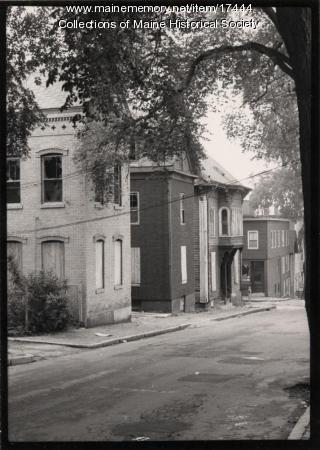
Above: Franklin and Oxford Streets in the 1950s. The other historic photo (below) shows another stretch of the long-lost Franklin Street (historic photographs courtesy of Maine Memory Network)
Here's some good news, though: my new buddy Patrick writes about schemes to repair past urban renewal idiocy with a new Franklin Boulevard in the Bollard this week: read about it here. Tomorrow at the Franklin Towers will be a "revisioning workshop" to brainstorm new ideas for the blighted pavement - perhaps I'll see you there. Finally, here's a previous post about fixing Franklin Arterial.
Posted by
C Neal
at
11:16 AM
0
comments
Labels: history, pavement pollution, sadistic design, streets
Learn more, and find out where you can purchase a copy.