A blog for better streets and public spaces in Portland, Maine.

Thursday, July 26, 2012

Press Herald: Portland car registrations down 24% since 2004, even as population increases

For the past week, Portland Press Herald reporter Tom Bell has been researching a story on Portland's declining rates of car ownership. The story ran in today's paper, and even I thought that its findings were surprising: the number of registered cars in the city has fallen, Bell found, by 24% in the last 8 years.

And, a corollary: because Portland one of the few places in New England that people can live without the hassles and expenses of car ownership, it's becoming an increasingly attractive as a place to move to: "the city's apartment vacancy rate of 2.5 percent was tied with Minneapolis as the nation's second lowest," writes Bell, "behind only New York City, according to a survey by the National Association of Realtors."

This is a trend we've been hearing about on the national level for quite some time, and particularly where my generation is concerned. But what Tom found locally was particularly striking. Even before the Great Recession began, the number of registered passenger vehicles was declining steadily, even as the city's population has been on the rise:

Source: Portland Press Herald

Bell's article profiles a few Portlanders who have gotten rid of their cars in recent years and don't regret it. They cite the many hassles of car ownership: onerous paperwork, the expense, and the deleterious effects that cars have on the urban landscape and the environment in general. But the cost factor seems to be the most important one. The American Automobile Association estimates that owning a car costs, on average, roughly $9,000 every year. So getting rid of a car can provide a huge boost in a household's disposable income. I personally don't think that it's been much of a coincidence that Portland has gained dozens of new neighborhood-oriented businesses and restaurants in this same 8-year period that car ownership has fallen off a cliff: without the hassles and expenses of babysitting cars, we have more time and money to spend right here in the city. Bell's story alludes to this phenomenon as well:
"The decline of car ownership presents opportunities for the city's economy. Its high population density, mix of services and retail stores, access to public transportation, car sharing services and extensive bicycle network have made it not only possible to live without a car but made the city a magnet for those who want to."
And as more car-free households move here, more businesses will be able to spring up to serve their needs in the neighborhoods where they live. It's a virtuous cycle that's leading us to a more vibrant, prosperous city.

This is a positive trend. But it's happening in spite of the city's housing and transportation policies, which are still focused overwhelmingly on building cheap or free parking.

In the same 8-year period that car ownership went down 24%, the City of Portland sunk millions of dollars into tax-subsidized parking garages in Bayside and the Eastern Waterfront district, while public bus services, which are still frustratingly meager, haven't received any new investments from city government. And in spite of our housing shortages, it's still largely illegal for developers to build new homes without expensive parking spaces; every single "affordable" housing development built by the city's nonprofit developers in recent years has been forced to include expensive and little-used parking garages.

People want to live in Portland without worrying about automobile ownership. The City ought to let them, instead of forcing them to pay exorbitantly for roads and parking we don't use.

Wednesday, July 25, 2012

That Was Quick: The Renovated Civic Center Loses Its Lustre, Weeks Before Construction Begins

Last fall, when County bureaucrats were trying to razzle-dazzle voters into lending them $33 million to renovate their hockey arena (subsidized minor-league hockey being apparently the last, tenuous raison d'ĂȘtre for the existence of county government), they publicized these architectural renderings of a newly-renovated Civic Center:

This week, the County went to the planning board to get final approval. The architects' drawings have changed a bit:
This second image represents what's actually being built. It's like a $33 million trip for second helpings at Old Country Buffet: the same bland, ugly architecture that made you sick the first time around — only now, there's even more of it!

Friday, June 29, 2012

Riding the Bus from Boston and New York to Portland

It must be summer — this site's seeing a big spike in traffic from people searching for "Portland-Boston bus" or "Portland to New York City bus".

If you're one of those people looking for a weekend getaway to the refreshingly mild, beachy shores of Casco Bay, here's a few tips from someone who makes the Portland-to-NYC bus trip pretty regularly.

  • Concord Coach is the best way to get between Boston and Portland. They have buses that depart nearly hourly in each direction, they show movies (bad ones, usually), they offer free wi-fi, and the trip takes less than 2 hours. If you're coming from Portland, they'll also give you a free snack as you board.  
  • You can almost always stow a bicycle in the luggage compartments of all the intercity bus services between NYC and Portland, Maine. The coach companies emphasize that they'll make no guarantees, but they've never not had room for my bike — even on buses packed with students headed to college with all their luggage. That said, they make no guarantees that there will always be room, so be prepared to leave your bike locked up at the station. 
  • If there's no room for your bike on the bus, or if you don't feel like lugging it along with you, there are a few bike rental options in Portland once you arrive here.
  • In Boston, Concord Coach stops at the South Station bus terminal, the same place where buses from NYC stop. There are lots of choices for trips between Boston and NYC. The Bolt Bus and Megabus are more comfortable, usually, but because they stop in midtown Manhattan, they spend more time stuck in traffic. Lucky Star and Fung Wah are cheaper and faster, you can buy a walk-on ticket from their office right before you leave, and, if you're headed to or from Brooklyn, their pickup/dropoff location at the foot of the Manhattan Bridge is more convenient.
  • In the summertime, Concord Coach also runs two buses a day up Route 1 to Bangor, with stops in coastal towns like Brunswick, Bath, Freeport, Rockland (where you can catch the ferry to Vinalhaven), and Camden. With advance reservations, you can also catch a connecting bus from the Bangor terminal to Acadia National Park.
  • The one drawback to taking Concord Coach is that their Portland station is in the boondocks, surrounded by freeway offramps. Cabs are cheap, though, and you can also take METRO's Route 5 bus, which stops there roughly every 20 minutes during the daytime hours (local bus schedules are on Google Maps).
  • The train is also an option, on the Amtrak Downeaster from Boston to Portland, but it takes about 40 minutes longer than the bus trip. It also leaves from Boston's North Station, so it's a harder connection to make if you're traveling from the south. Because of the gap between Boston's South Station and North Station, there's no train that connects straight through from southern New England to Maine.
  • Avoid Greyhound. They're more expensive and they have worse service.

Wednesday, June 27, 2012

New Veterans' Memorial Bridge Opening Tomorrow

The new Veterans Bridge (first speculated about here back in 2008, then discussed again back in 2010, when a design and construction team was first selected) is finally opening tomorrow, on June 28th, 2012, with a fantastic new bicycle and pedestrian pathway that extends all the way from the West End to South Portland's Ligonia neighborhood.

You have a few more hours to enjoy the new bridge without any traffic. It will be open to pedestrians and bicyclists only until the end of a grand opening ceremony, which runs until 11:30 am tomorrow. After that, cars will roam free on the main lanes, but bikes and pedestrians will still be able to enjoy a nice wide path on the southern edge of the bridge all to themselves.

Corey of Portland Maine Daily Photo took some nice shots of the new, empty bridge late last week; you can take a look here.

Tuesday, June 19, 2012

Calming Outer Congress

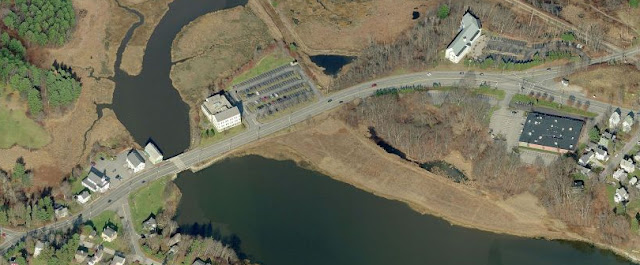
Outer Congress Street, between Stevens Avenue and the Stroudwater neighborhood, is a choke point in the city's bicycle and pedestrian network. Aside from long detours through Westbrook or South Portland, it's the only non-freeway connection between Portland and the Jetport area, a district with thousands of jobs and some of the region's biggest employers. It's also a gateway to one of the city's most scenic parks, the Fore River Sanctuary.

Unfortunately, it's been designed to be a dangerous speedway for cars. Large sections of the street don't even have a sidewalk, leaving bus riders to wait in the ditch. The natural surroundings give drivers the impression that they're in the countryside, not in a city, so that many of them hit speeds of 40 to 50 miles an hour along this relatively short stretch:

Image: via Bing Maps

When I first moved here in 2006, Stroudwater neighborhood residents had prevailed on the city to do a traffic study of outer Congress Street. Unfortunately, the hired engineers took it for granted that moving cars would continue to be the most important role for this public space. They also predicted, wrongly, that traffic would increase considerably. The study recommended only minor changes, and  the public that paid for it had little appetite to implement its recommendations.

This year, the Maine DOT is repaving the section of Congress from roughly Stevens Avenue to Johnson Road near UNUM. This presents an opportunity to make some more meaningful improvements, and city staff have revisited the old study to examine where it went wrong, and how its recommendations might be revised to make more meaningful changes for everyone's safety.

It's a good start. But to make more permanent changes, like landscaped medians designed to slow down traffic and give pedestrians a safer place to cross the road, the city will need to spend some of its own money.  The capital budget under discussion includes $175,000 line-item to install more traffic calming, better sidewalks and crosswalks, along outer Congress Street. Please write to your city councilors to ask them to support this expenditure (and if you do, please leave a comment with their response —we're trying to keep track of who's on board with this).

Here's an outline of some of the changes being proposed for the short term. You can take a look at maps at the city's website.

  • Large sections of Congress Street will be constricted to one inbound lane with a left turn lane and two outbound lanes. This basically formalizes the status quo, where the inbound left lane is usually filled with cars waiting to turn left anyhow...
  • ... but it also opens up the opportunity to create new median islands and crosswalks with pedestrian refuges, especially at intersections like Westbrook Street and Frost Street, or close sidewalk gaps, like the one between Stroudwater and Frost Street. It's also bound to help calm down inbound traffic.
  • Near the railroad tracks (from near Frost Street to the Italian Heritage Center driveway), the road will narrow to one lane in each direction, with space in the middle for future left-turn lanes and/or landscaped median refuges. Pending the city's budget, this area could be the future location for a nice crosswalk to connect the Portland Trails network across Congress Street; the extra space could also be put to use to widen the sidewalks or provide better bus stops. 
  • "Bikes May Use Full Lane — Change Lanes to Pass" signs (pictured) would be installed at several locations between Johnson Road and Stevens Avenue, giving motorists notice that they should expect bikes in the roadway and giving cyclists an opportunity to question the literacy of the sad, road-ragey motorists who honk at them.
  • Inbound cyclists would also gain a climbing bike lane between the Fore River Bridge and Westland. This section has a blind curve, where slow-moving cyclists climbing uphill in the right lane are out of sight of speeding motorists coming up from behind. Even experienced cyclists doing everything right are one texting-and-driving teenager away from a disaster (it's a little better on the other side of the street, heading out of town, and there won't be new bike lanes on that side of the road). Like a truck climbing lane, this bike lane will give slower vehicles a little extra room; hopefully it will be combined with more permanent traffic calming so that the cars move a little slower as well.

Wednesday, June 6, 2012

Good News on India Street

Opechee Construction, the company that built the new mixed-use hotel building on Fore and Franklin Streets last year on part of the former Jordan's Meats site, has submitted applications to develop the eastern portion of the same site. I'd like to highlight it here, and complement Opechee on one of the best development proposals that the city has seen in years. Here's what it could look like, pending the city's approval, which ought to come next month:

Fore Street view (India St. on right):


Middle St. facade (India St. on left):

This is a great-looking project, and I'd . The Fore Street face of the building would feature a level of retail space with condominiums above; the Middle Street facade, which faces the small restaurant row of Duckfat, Ribolita, and the East Ender, would have street-level retail space with offices above. It's a large building, but Opechee's architects have articulated the facade to introduce variation and interest, to give the appearance of three or four smaller buildings.

It's always hard to judge from renderings, but I really think that this is going to add a lot of life to the India Street neighborhood, and draw Portland's center of gravity eastward across Franklin Street.

But in spite of the ho-hum overall design of the Hampton Inn building completed last year, it still succeeds because they did put extra effort where it really matters, in the small, street-level details: an outdoor seating area in front of the brewpub, windows that look into the kitchen's buzz of activity from the Franklin Street sidewalk, a granite public stairway leading to a pleasant alley off Franklin Street, and attractive light sconces and awnings located just above a pedestrian's eye-level.

This new building is packing in even more activity and detail to engage the street: lots of retail space and attractive storefronts, plus balconies above to draw the building's occupants outside (where they'll be able to enjoy views of Casco Bay).  When built, Middle Street east of Franklin Street will have as much or more going on at street level as any street in Portland.

And by replacing an empty lot with a building, it will also create a nicely enclosed outdoor "room". Tourists will be able to peer east from Post Office Park and see, in the distance, what looks like an interesting block of restaurants and shops. And more likely than not, they'll wander across Franklin Street — currently a huge psychic barrier — to get there.

The project is also one of the most progressive in the city in terms of how it provides parking. There is a small garage, but it's tucked in behind the storefronts, and is the minimum needed for the adjacent hotel and for the condos. The developers are asking office tenants to take responsibility for finding their own parking spaces, either through off-site leases or through the city's new (and still unused) Fee In Lieu of Parking ordinance.

One more thing: two years ago, Opechee came to the city with a proposal to build an ugly two-level parking garage on this same site (here's the post I wrote back in August 2010). Neighboring businesses rejected having too much parking in their neighborhood, and asked the developers to embrace a higher-value, pedestrian-friendly vision for the district.  So it's very much to Opechee's credit that they listened to their neighbors and went back to the drawing board to craft this much-improved proposal.

Thursday, May 10, 2012

Seek Alt. Routes: Bicycle-Powered Experiences at SPACE Gallery

If you're riding your bike down Congress Street this month, stop by SPACE Gallery and make a contribution to their "Seek Alt. Routes" show. The walls have been given over to prompts for bicycle explorations and collections of found objects and images from Portlanders' bike rides.

 The idea is to encourage more people to be more engaged with our city - by riding a bike, we can be more open to the sights and sounds of our community, and better able to understand our neighbors and neighborhoods.

Find out more here: Seek Alt. Routes: Recording Bicycle-Powered Experiences