A blog for better streets and public spaces in Portland, Maine.
Showing posts with label sadistic design. Show all posts

Monday, September 29, 2014

Traffic engineers *still* want to widen Franklin Street

At left: Gorrill-Palmer Engineers' proposal for an 8-lane Franklin Street, blocking the Bayside Trail crossing between Marginal Way and Somerset Street.

This Wednesday, Oct. 1, will be the second public workshop for the Franklin Street redesign study. It starts at 5:30 p.m. in the main library's Rines Auditorium (on the basement level).

There's some good stuff being planned, but the team needs to be challenged – forcefully – on their proposal for the northernmost section near Marginal Way, pictured at left. 
 
Traffic engineers from Gorrill-Palmer – the same guys who proposed turning Franklin into a full-on freeway ten years ago – seem to have missed the long discussions about how this study's purpose was to make Franklin Street safer and friendlier to foot traffic. 
 
Instead, they've sketched out plans to widen Franklin from 6 lanes to 8 lanes north of Somerset Street. 
 
The proposal would make the intersection of Franklin and Marginal Way one of the most massive intersections in the greater Portland region – almost as big as the junction of Route 1 and Gorham Road at the center of sprawl-choked Scarborough.

The traffic engineers claim that extra lanes are needed to accommodate their forecast of 8% more cars by 2030. In other words, motorists will get more space to accellerate to freeway speeds, and pedestrians will get longer crosswalks and more opportunities to get maimed by motorists.

This section of Franklin would be the first section to be reconstructed (in 2016), so it's important to get it right – or at the very least, not make it any worse than it is today.

If you're coming to Wednesday's workshop, a good question to ask might be why we need 33% more lanes built in 2016 in order to accommodate science-fictional traffic that won't exist for another 15 years (if ever)?

Another good question to ask is whether the traffic engineers would be willing to film their children, or elderly parents, spend a weekday rush hour crossing this street on their own.


Tuesday, May 11, 2010

Unelected Bureaucrats tell City Council: "Screw You, Augusta Knows Best"

Update: The League of Young Voters has sent out an action alert, asking members to call Governor Baldacci (287-3531) and hold his administration's highway planners accountable (a sample call script is below)

"Doesn't the Gov. want to promote energy independence? Blocking willing pedestrians with chain link fences and threatening their safety with unmarked street crossings next to the Park and Ride lot is not the way we would suggest promoting efficiency."


Last month, the Portland City Council passed a resolution calling for the Maine DOT to include basic pedestrian safety facilities when it widened Exit 7 at the junction of Franklin Street and Marginal Way. Exit 7, you may recall, is a long-planned trail connection between Bayside and Back Cove under I-296, the state-owned traffic sewer that monopolizes valuable waterfront real estate.


Traffic levels are still flat, and Augusta is still billions of dollars short of being able to do basic road repair for most of the state. But the Maine Department of Transportation is nevertheless STILL shoving forward a multi-million dollar freeway widening here. It recently released plans for construction, and intends to take bids from construction firms beginning on Wednesday.

Last month, the Portland City Council passed a resolution that this project would include basic sidewalks and crosswalks for pedestrians to negotiate their way between the busy Park and Ride Lot, the new developments on Marginal Way, and the Back Cove Trail. A trail connection between Marginal Way and Back Cove at this location has been called for in the City's Comprehensive Plan since 1990.

Also last month, Federal Transportation Secretary Ray Lahood declared "the end of favoring motorized transportation at the expense of non-motorized."
"We are integrating the needs of bicyclists in federally-funded road projects. We are discouraging transportation investments that negatively affect cyclists and pedestrians. And we are encouraging investments that go beyond the minimum requirements and provide facilities for bicyclists and pedestrians of all ages and abilities. [source]
But Augusta's construction drawings conspicuously omit any pedestrian safety measures in defiance of local elected officials and these new federal policies (not to mention basic common sense).

The plans would only build a short, 8' wide sidewalk under the freeway overpasses themselves. This sidewalk wouldn't be connected to the Back Cove Trail or the Marginal Way sidewalk. Quite the opposite: MDOT is actually going to spend a few thousand taxpayer dollars on not one but two chain-link fences to prevent anyone from using the sidewalk (at least until volunteers from the neighborhood "repair" the fences themselves).

This sidewalk would not have any lighting. It would be a narrow, dark alley squeezed next to speeding freeway traffic. Remember, they're calling this a "safety improvement".

MDOT is also refusing to build any crosswalks between the Park and Ride lot and adjacent sidewalks on the other side of Franklin Street and Marginal Way.

The plans do allow for future crosswalks to be built, someday. But they are conspicuously labeled "BY OTHERS," meaning that the State of Maine is refusing to pay for them. Instead, local Portland taxpayers will have to pay the bill to clean up MDOT's mess.


I find it pretty incredible that a few unelected bureaucrats in Augusta feel entitled to defy local elected officials so brazenly. Is Portland's City Council really going to take this?


Update: The League of Young Voters has sent out an action alert: "Can you make some time today to put in a quick phone call to the Governor and let him know what his administration is up to? The office's number is 287-3531. "


Here's a sample call script, written by local activist Steve Scharf:

Hello my name is ________ and I am calling about MDOT's plans for the I-295 Exit 7 in Portland project. I am appalled that after the public and the City of Portland has made it clear that they want a fully functioning, well-lit, 10' wide trail connection with crosswalks, that the bid is going out with no crosswalks and two chain link fences to block access between Back Cove and Marginal Way.

Please pull this bid document back and add the requirements to make this a fully usable trail connection in the city of Portland.

Again my name is _______________________, my phone is ____________ and my email is ___________. Thank you for taking my concerns into consideration.

Wednesday, August 12, 2009

Seriously?

Elm Street in Bayside. This is the main route between downtown Portland and the new district of mid-rise office buildings sprouting up along Marginal Way:

Photo by Corey Templeton, originally published in his Walk Around Portland blog.

Sunday, November 30, 2008

Downtown Yarmouth, Maine

For anyone who still has any doubts about how brain-dead and/or sadistic Maine's traffic engineers are, I present these photographs of Route One through the village center in Yarmouth, Maine.


This is the view towards the town post office and a large elderly housing complex. The town's main supermarket is just up the hill from here. Hundreds of homes lie within a half-mile radius of this intersection, and would be within easy walking distance of these village-center services if the road through the center of it all weren't explicitly designed to promote speeding, aggressive driving, and road rage in general.

And here's a detail of the crosswalk. If you've successfully managed to cross five lanes of traffic without getting hit, they've thoughtfully installed a guardrail that forces you to stay in the roadway for just a while longer. It's like they've offered you a ladder out of a pool of sharks, but the last three rungs are missing.


After decades of mismanaging tax dollars and bungling the design and construction of our transportation infrastructure, MDOT is now facing big shortfalls and substantial layoffs. Couldn't happen to a nicer agency, if you ask me.

Friday, August 17, 2007

The Civic Center (From Hell) That Never Was

Hi. I'm Patrick Banks, and I'll be contributing to this blog from time to time. Thanks, Christian! Anyway, take a look at the picture below:
That's Deering Street, from the corner of State looking toward the Eastland Park Hotel. Thomas Brackett "Czar" Reed used to live right on this corner. A lovely chunk of Portland, is it not? Much lovelier than, say, the Cumberland County Civic Center. Amazingly enough, this neighborhood almost ended up becoming just that. 40 years ago urban renewal (actually removal) was the still the "new black" for urban planners all across the land. Portland's planners were no exception and they hired the firm of Victor Gruen (father of the modern suburban shopping mall) & Associates to draw up a plan for a new Portland.

Gruen's plan for Portland - titled Patterns for Progress - was pretty grim. Among other mad schemes, Gruen's firm envisioned a ring road around downtown, tunnels under Monument Square, a pedestrian mall along Congress Street, an orgy of demolition, and plenty of parking garages.

Then there was the civic center. Gruen and his minions actually wanted to plop a gigantic civic/convention center right on top of the blocks bounded by State, Congress, High, and Cumberland (and bisected by Deering). Not everything on that site would have been paved over - The State Theater and the Portlander Motor Hotel (today's USM dorm) would have been integrated into the complex, and the Baptist Church on the corner of High and Deering would have been allowed to stand as well. Everything else in this huge tract of land, however, would have been S.O.L. How on Earth did Gruen's minions come up with such a crappy idea? Crack cocaine wasn't invented until at least a decade later, so they couldn't have been smoking that. PCP, maybe? In any case, they were out of their friggin' minds.

Fortunately their version of the civic center never came to pass. (I'm not entirely sure why. I think it had something with Portland being totally broke. Yay poverty!) So next time you're in the neighborhood, give thanks to it's continued existence by eating dinner at Uncle Billy's, grabbing a 40 from Joe's, and heading over to a show at Geno's. Try doing anything like that on the median strip of the Franklin Arterial.

Monday, August 13, 2007

The Maine State Pier: Onramp to the New Franklin Superhighway


The Peninsula Traffic Plan of 2005 recycled the 1960s-era concept of turning Franklin Arterial into a six-lane trench of freeway traffic. Unsurprisingly, the Plan failed to garner any popular support, and it remains in limbo.
The Peninsula Traffic Plan of 2005 was universally panned and consigned to the dusty files of City Hall's netherworld for its complete lack of consideration for anyone who might want to navigate downtown Portland without an automobile.

Written by suburban traffic engineers Gorrill-Palmer1, the Peninsula Traffic Plan envisions a few nightmare scenarios for downtown Portland: eight lanes of speeding traffic at the edge of Deering Oaks Park, a six-lane Franklin Arterial that runs through a trench through downtown, streets so dangerous that pedestrians need bridges in order to cross them, and numerous other wet dreams for anyone who yearns for the halcyon days when we wantonly bulldozed our cities to make way for more cars.


At the intersection of Marginal Way and Franklin, GP proposed nine lanes of traffic. The proposal would be so dangerous to pedestrians that a separated bridge (yellow dotted line) would be necessary in order to cross.
In spite of its shortcomings, certain foul elements of the Peninsula Traffic Plan refuse to die. Most recently, the idea of widening Franklin Arterial at Marginal Way has been revived, and traffic engineers are trying to link the idea to the mess on the Maine State Pier. A May 21 memo (see page 9) from MDOT engineer Stephen Landry to developer Ocean Properties states that
"...some off-site mitigation is expected to be required, including additional turn lanes or traffic signals and possibly some ramp widening at Franklin Street I-295 interchange...

It matters little that this memo was written for Ocean Properties; the other development team (Olympia) is also planning on building more off-site parking, which will still clog area roadways and justify widening projects in MDOT's worldview. Plus, Olympia's traffic engineers aren't exactly progressive urbanists: they happen to be the same Gorrill-Palmer firm that wrote the bankrupt Peninsula Traffic Plan of 2005.

So how can Portland citizens keep the development on the Maine State Pier from becoming an on-ramp to the dreaded Franklin Superhighway to Hell? Simple: write to your City Council (you can find the e-mail addresses above in the next post - avoid the "black hole" on the City's web page) and demand that a project of this size should be postponed until Portland completes its upcoming study of pedestrian, bicycle, and transit traffic downtown.

Unless that happens, we can count on more cars, more air pollution, more pavement, and more misery in general from these developers.

1Perhaps not coincidentally, Gorrill-Palmer Consulting Engineers, Inc. operates in the village of Gray, Maine, a locale for which years of intense traffic from the nearby Maine Turnpike has driven the town to designate "blighted" status. In other words, years of traffic engineering prescriptions of the sort contained in the Peninsula Traffic Plan have made a literal slum of Gorrill-Palmer's own hometown.

Thursday, July 5, 2007

The Maine Turnpike Authority Resents Your Legs

The Maine Turnpike Authority (MTA) is trying to gain approval for a new headquarters building at the junction of outer Congress St. and the Jetport Connector Road. In the process, they're trying to weasel out of the City requirement that they build sidewalks around the property:

"The Jetport and [sic] Connector Road were [sic] constructed by mutual agreement between the MTA and the City to be without... sidewalks for pedestrians... For safety and efficiency reasons it was therefore agreed that pedestrian use of this area would not be encouraged."
- MTA Request for Reconsideration to the Portland Planning Board, May 17
If it had a sidewalk, the Jetport Connector Road would offer an easily walkable 1/2 mile connection to the nearest bus stop on Western Avenue (on existing sidewalks, it's a less realistic 3/4 mile walk). But at a recent Planning Board meeting, Turnpike Authority officials and transportation engineers made it clear that they had no clue where the nearest bus routes or stops were.

Additionally, the new headquarters building would be surrounded by a four or five acres of parking lots, and they plan to build 50 more parking spaces than are required by Portland's suburban office-park zoning codes. Located in the headwaters of Maine's most polluted watershed (Clarks Pond/Long Creek), these parking lots will soon be sending more oil-soaked runoff downstream towards the Maine Mall.

A cynic would find this only natural - pedestrians, transit riders, and petro-poisoned waterfowl don't pay the tolls that fatten the Authority's political-patronage salaries. But this is an agency that is supposedly governed by a law that requires a focus on "other transportation modes" and "energy-efficient forms of transportation," so its employees' complete ignorance of bus routes is rather striking. And considering the Authority's multi-million dollar annual budget, its strident refusal to build a few yards of sidewalk around its new offices seems as petty as it is shortsighted.

Wednesday, May 30, 2007

They Bulldozed It


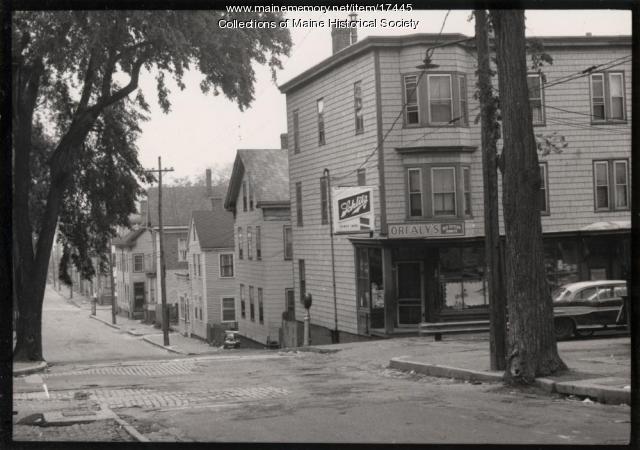
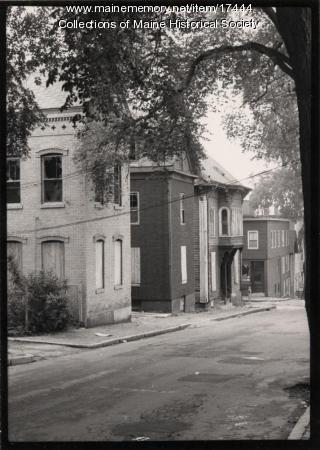
Above: Franklin and Oxford Streets in the 1950s. The other historic photo (below) shows another stretch of the long-lost Franklin Street (historic photographs courtesy of Maine Memory Network)
This photograph here is what the corner of Franklin and Oxford Streets looked like about 50 years ago, before the WASPs on the City Council noticed the Irish name on the corner store, called it a "slum," and bulldozed it all to create the hated Franklin Arterial.

Below, another photograph from the same site of another spot on the former Franklin Street. It's hard to know exactly where, since the buildings, shady elm trees, and even the sidewalks have been gone for decades. For those readers who have never been to Portland, here's what urban renewal gave us instead: a grass median full of garbage, some scrubby trees growing over the old neighborhood's rubble, and four lanes of traffic unencumbered by crosswalks or sidewalks. Here's a photo (the Franklin Towers, Portland's tallest building and a fine example of Soviet Sentimental architecture, commands a fine view of the no-man's-land):


Note how all of these "slum dwellings" in the old photos bear striking resemblance to historic homes that now sell for over $1 million in surrounding neighborhoods. Way to invest in real estate, you jingoist highway-engineering dipshits.

Here's some good news, though: my new buddy Patrick writes about schemes to repair past urban renewal idiocy with a new Franklin Boulevard in the Bollard this week: read about it here. Tomorrow at the Franklin Towers will be a "revisioning workshop" to brainstorm new ideas for the blighted pavement - perhaps I'll see you there. Finally, here's a previous post about fixing Franklin Arterial.