A blog for better streets and public spaces in Portland, Maine.
Showing posts with label housing. Show all posts

Thursday, February 21, 2019

Why is Portland wasting affordable housing funds on empty parking lots?

Last night the city of Portland declared a parking ban in advance of a snowstorm, which means that everyone had to move their cars into off-street parking lots.

And here's what the 22-space parking lot at Avesta Housing's Bayside East building (a low-income housing complex for seniors) looked like:

There were two more cars parked in the handicap spaces outside of the shot, but still, this is what I'm talking about when I kvetch about the wastefulness of Portland's and MaineHousing's parking requirements.

This parking lot was paid for in part from Maine's Low Income Housing Tax Credits, which are a) extremely limited and b) intended to subsidize affordable housing, not to subsidize our most unaffordable form of transportation.

Building this parking lot forced Avesta to set aside more than half of its 1/3rd acre parcel (adding ~$150,000 in land costs to the project) for pavement instead of for housing. What is today a 20-unit apartment building could have housed *twice* as many low-income households if the city and MaineHousing had not forced them to waste this real estate.

And, on an ongoing basis, this parking lot also forces Avesta Housing, a nonprofit agency, to spend thousands of dollars every year plowing, sanding, patching potholes and paying stormwater fees for an ugly field of asphalt that, as it turns out, their tenants don't want even when it's being given away for free!

Over the years, Portland's affordable housing developers have pissed away millions of dollars' worth of our state's limited low-income housing funds to build parking lots and garages like this one. Imagine how great our bus system could be if that money had been spent on METRO improvements instead.

Maine has over 30,000 renter households that don't own any cars, and Portland is one of the few places in the entire state where those families can live well without an automobile.

It's plainly wrong to mandate that a parking lot is the best way to solve low-income renters' mobility needs. Given the extortionist terms of subprime auto loans and the high costs of car maintenance, expecting low-income tenants to bring their own cars instead of helping them pay for transit passes is borderline sadistic. These families need apartments and better transit service much more than they need free parking, and Portland, as a city, needs planning laws and low-income housing financing rules that recognize this fact.

Wednesday, December 3, 2014

"Keep Portland Livable" is making Portland's gentrification problem worse

A couple weeks ago, we learned that Peter Monro and Tim Paradis, the two men behind “Keep Portland Livable,” had been working closely with the developers of the proposed Midtown development in Bayside, and will now support a revised proposal with a large reduction in housing.

I'd been reserving judgement on this turn of events until I'd had a chance to see the revised plans. Now that those have been posted on the city's website, I'm pretty disappointed. The new project is, however, entirely consistent with the privileged mindset of the well-to-do homeowners who bankrolled "Keep Portland Livable." Here are some of its problems:

They subtracted lots of the housing, but kept most of the parking.
The most credible complaints from “Keep Portland Livable” concerned the massive parking garage being proposed. But, in the updated version that bears the Paradis/Monro seal of approval, the massive garage is still there, and it actually grew an additional level.

In fact, it now would stand as the tallest, most prominent edifice in the revised proposal (pictured at right). How's that for symbolism?

The new Paradis/Monro project dedicates a much higher proportion of real estate to car storage than to people. The original plan was to have about 1.3 parking spaces per apartment. But under the new plan, each apartment will have 1.8 parking spots. That’ll help “keep it livable” for wealthier residents who want to bring multiple cars with them into the heart of the city, but it's going to make the city's streets less livable for everyone else.

It won't be more affordable; in fact, it will likely be more expensive.
The revised proposal makes no provisions for more-affordable housing — indeed, with hundreds of fewer apartments available in this new proposal, the developers will need to charge substantially higher rents for each unit in order to satisfy their investors and break even on construction costs. And speaking of rent inflation...

The truncated apartment buildings in the revised proposal (bottom, above) will have fewer apartments, and therefore they'll only be "livable" to half as many families.
It's a lost opportunity to address Portland's housing shortage.
The original proposal would have had up to 850 apartments. The revised project, with only 440 apartments, gives 410 fewer households the opportunity to live within short walking distance of three supermarkets, a dozen bus routes, downtown retail services and thousands of jobs.

Hundreds of new families are moving to Portland each year. Many are moving from places like Los Angeles or Brooklyn out of a desire to live in an attractive city near the ocean; many others are moving from rural areas out of necessity to live near health care and social services.

How the city makes room for these newcomers is a largely unresolved question.

Now that the "midtown" proposal has been scaled back with 410 fewer homes, it’s not as though 410 apartment-seekers who would have lived in the high rises will simply evaporate into thin air. Instead of occupying a long-vacant lot in Bayside, many of those newcomers will instead take over apartments and homes in established neighborhoods like Parkside, Munjoy Hill, or the West End (where Monro himself settled a few years ago when he arrived here from Massachusetts).

Or, if they don’t take over housing in Portland, perhaps they’ll join the thousands of migrants taking up residence in suburbs like Scarborough and Windham instead, where running even the most basic errands require burnt offerings of fossil fuels.

It's a terrible precedent for civic planning
The original 'midtown' proposal was faithful to the city's "New Vision for Bayside," a 1999 neighborhood plan that explicitly called for high-rise buildings and hundreds of new apartments to be built on this site to make Bayside feel like an extension of downtown and to help reduce suburban sprawl in rural communities outside of Portland. It was a good plan, and these developers collaborated closely with city planners and neighborhood leaders as their plans coalesced over a period of several years.

The opinions of two wealthy dudes aren't supposed to trump the city's long-standing economic development and housing policies. But the "Keep Portland Livable" guys have shown us a new, unwelcome truth for our income-stratified city: that those with the privilege to buy their own lawyers, public relations flacks, and lots of Facebook advertising can assert a de facto veto over the city's progressive housing goals and neighborhood-based planning process.

No urban plan will ever satisfy everyone, but the city's planning process is intended to balance and prioritize countervailing concerns (for instance, the overwhelming need for new housing, versus a few residents' aesthetic preferences for horizontally-oriented groundscrapers).

If the city's wealthy citizens are going to veto any new housing proposal that they don't like, then the city will quickly become inhospitable to everyone but the wealthy.

Urban design needs to be less elitist
I've heard from several people in the past few weeks who have seen the new plan, observed its weaknesses and wryly concluded that Paradis and Monro have "sold out" their values by agreeing to this compromise.

Saying that they've “sold out” misjudges the men’s intentions, though. Peter Monro and Tim Paradis are wealthy homeowners (Monro would really like to tell you about his recent two-month Spanish vacation), whose West End and Old Port property puts them in Portland’s top stratum of real estate wealth.

The city's housing shortage simply isn't a problem for these guys. And so, in the absence of real problems, it makes a certain amount of sense that they'd get so wrapped up in a first-world problem like a moderately tall apartment complex being built in the middle of the city.

Still, struggling to maintain some degree of egalitarianism in our cities against the desires of an increasingly powerful and wealthy 1% will be the defining challenge of urban planning in the next few decades. These guys are on the wrong side of that struggle. As Victor Gruen was to freeways, so Keep Portland Livable is to gentrification.

The challenge for the next generation – my generation – is to make sure that our revitalized cities will still make room for the diversity of people who would like to live in them. Keep Portland Livable's midtown intervention – like the destructive urban renewal of the last century – is an instructive example of what not to do.

Friday, December 20, 2013

Make middle-class housing legal

A lack of new housing in the walkable, transit-oriented neighborhoods of the Portland peninsula is one of our biggest barriers to creating a more sustainable region. Thousands of households all over New England would love to live in a city like Portland where it's possible to live well without an automobile — and in spite of this demand, virtually no new middle-class housing has been built in the central city during the past decade.

Why should this be? I have a column in today's Portland Press Herald looking at some of the reasons our city's becoming increasingly unaffordable, and here's the short version: our current zoning laws make it mathematically impossible to build an affordable home in the city.


Go to any planning meeting and you’ll see that the people complaining about taller buildings and parking issues are almost always well-off. Unlike the working poor, they have the leisure time to attend long planning meetings and influence zoning policy. Our “public process” is inherently biased against progress and the people who need housing the most.

That’s why it’s so important for those of us who possess the privilege of being able to participate in these civic discussions (this means you, opinion page readers) to maintain some perspective about how our bourgeois desires in urban design weigh against the greater needs of our most vulnerable neighbors.

Shadows from taller buildings, or finding free storage for your four-wheeled private property – those are First World problems. Dozens of your neighbors living in the shelters for want of stable housing: That’s a real-world problem, and we need to work harder to solve it.

Wednesday, October 24, 2012

Why I Care About Housing

These are the chief reasons why I care about housing policy — and specifically, why City Hall needs to do a lot better when it comes to building more housing in-town:

  • As an environmentalist, I'm most concerned about global warming and our addictions to fossil fuels. In Maine, a lot of our electricity already comes from renewable sources, and we're making good strides on energy efficiency in buildings. Moving more people closer to where they live and work — into neighborhoods where they can walk and bike to run most errands, or, at the very least, drive much shorter distances — is the most effective thing we can do at the local level to make a dent in oil addiction.

  • More in-town residents means more sales for local businesses (plus more local businesses starting up to serve residents: see Reny's, for instance). I don't think that it's any coincidence that the boom in new restaurants and storefront occupancy downtown has coincided with the rapid rise in gas prices during the past 8 years: people living downtown earn similar wages as people from the suburbs, but because they don't spend nearly as much of their paychecks on cars and gasoline, they have a lot more disposable income to spend in the neighborhoods where they live (and not at the Maine Mall).

    The more housing we provide in Portland, the more we'll shift regional household spending away from Big Oil corporations and towards local businesses.

  • And as a corollary to the above point, more local businesses, and more foot traffic on local streets, means that our streets and sidewalks become more vibrant, safer, and more interesting.

  • Last but not least, I'd like Portland to remain an egalitarian place for everyone to live. A place where the working poor and recent immigrants can find opportunity and secure a measure of economic security.

    The city's recent inflation in housing rents is a big threat to those ideals. Turning people away isn't a solution (unless you're OK with Portland suffering from the same kind of gentrification-onset blandness that ruined places like Cambridge and Brooklyn — and while a lot of shitheads are perfectly OK with that, I don't consider myself a shithead), and we should be pleased that there's an increasing amount of demand to live in-town.

    But if demand is rising, then the only reasonable way for the city to combat housing price inflation is by aggressively expanding the supply of housing that's available here.


I know that some of this blog's readers are more interested in architecture or bike infrastructure, but I hope that these points will convince you to be concerned about the city's housing policies, too.

I'm posting this this evening because earlier today my biweekly column in the Portland Daily Sun addressed the city's new plan to tackle homelessness in Portland. This, too, is a big issue that affects the security and sense of vitality in Portland's downtown streets and public spaces like Congress Square. The visibility and lousy treatment of our homeless population reflects poorly on our city. As I write in the column, the city's new plan is a good first step — but it also needs to come with meaningful commitments to the city's social services, and to building more apartments citywide.

Friday, September 21, 2012

The a-park-ment

Today is Portland's first participation in the global Park(ing) Day event. Jess and I, with Morgan Law of Kaplan-Thompson Architects, built this "a-park-ment" on Fore Street. It's been a fun day with lots of well-wishers dropping by and enjoying the new public space:


The a-park-ment is meant to draw attention to the city's housing shortage by noting the fact that a single parking space occupies roughly as much real estate as a small studio apartment (our structure, pictured above, actually didn't use the full length of a standard parking space).

Old news to anyone who reads this blog, but if City Hall sold its surface public parking lots — just a small fraction of the city's government-owned parking — for redevelopment, the real estate could contain over 20 new buildings the size of the new Oak Street Lofts building in the Arts District, with nearly 800 new housing units, which would generate an additional $1.25 million every year in new tax revenue for the city.

Just sayin'.

I've written a more detailed report with a lot more photos of the city's six inaugural Park(ing) Day parks over at the LiveWork Portland blog.


Thursday, July 26, 2012

Press Herald: Portland car registrations down 24% since 2004, even as population increases

For the past week, Portland Press Herald reporter Tom Bell has been researching a story on Portland's declining rates of car ownership. The story ran in today's paper, and even I thought that its findings were surprising: the number of registered cars in the city has fallen, Bell found, by 24% in the last 8 years.

And, a corollary: because Portland one of the few places in New England that people can live without the hassles and expenses of car ownership, it's becoming an increasingly attractive as a place to move to: "the city's apartment vacancy rate of 2.5 percent was tied with Minneapolis as the nation's second lowest," writes Bell, "behind only New York City, according to a survey by the National Association of Realtors."

This is a trend we've been hearing about on the national level for quite some time, and particularly where my generation is concerned. But what Tom found locally was particularly striking. Even before the Great Recession began, the number of registered passenger vehicles was declining steadily, even as the city's population has been on the rise:

Source: Portland Press Herald

Bell's article profiles a few Portlanders who have gotten rid of their cars in recent years and don't regret it. They cite the many hassles of car ownership: onerous paperwork, the expense, and the deleterious effects that cars have on the urban landscape and the environment in general. But the cost factor seems to be the most important one. The American Automobile Association estimates that owning a car costs, on average, roughly $9,000 every year. So getting rid of a car can provide a huge boost in a household's disposable income. I personally don't think that it's been much of a coincidence that Portland has gained dozens of new neighborhood-oriented businesses and restaurants in this same 8-year period that car ownership has fallen off a cliff: without the hassles and expenses of babysitting cars, we have more time and money to spend right here in the city. Bell's story alludes to this phenomenon as well:
"The decline of car ownership presents opportunities for the city's economy. Its high population density, mix of services and retail stores, access to public transportation, car sharing services and extensive bicycle network have made it not only possible to live without a car but made the city a magnet for those who want to."
And as more car-free households move here, more businesses will be able to spring up to serve their needs in the neighborhoods where they live. It's a virtuous cycle that's leading us to a more vibrant, prosperous city.

This is a positive trend. But it's happening in spite of the city's housing and transportation policies, which are still focused overwhelmingly on building cheap or free parking.

In the same 8-year period that car ownership went down 24%, the City of Portland sunk millions of dollars into tax-subsidized parking garages in Bayside and the Eastern Waterfront district, while public bus services, which are still frustratingly meager, haven't received any new investments from city government. And in spite of our housing shortages, it's still largely illegal for developers to build new homes without expensive parking spaces; every single "affordable" housing development built by the city's nonprofit developers in recent years has been forced to include expensive and little-used parking garages.

People want to live in Portland without worrying about automobile ownership. The City ought to let them, instead of forcing them to pay exorbitantly for roads and parking we don't use.

Saturday, April 21, 2012

The Free Market Has Spoken: Rich People Don't Need That Much Parking (So Why Are We Still Forcing It on the Poor?)

The Bay House condominium project planned for the old Village Cafe lot in the India Street neighborhood has languished for over five years now.

In 2009, after the housing crash, the developers revised their project to add more parking spaces to a ground-level garage, to offer two parking spaces for every apartment in the complex. The additional parking made the building proposal much uglier and much more expensive, but the developers believed, at the time, that the extra parking spots would lure wealthy buyers.

Turns out, they were wrong. The extra parking added expense to the project, without adding much value. In the three years since then, Portland's housing shortage has gotten worse, with skyrocketing rents. The new condominiums on the top floor of the Hampton Inn building across India Street sold out within months, without an on-site parking garage. 
 
Now, the Bay House developers are going back before the Planning Board to request changes to their approval to make the building more cost-effective — and buildable. While the 2009 plan called for 159 parking spaces for 82 condos (or 1.92 parking spots for every unit), the 2012 plan calls for only 80 on-site parking spaces for 94 condos (0.85 parking spaces for every unit), with an arrangement to lease parking spaces in the half-empty, city-subsidized Ocean Gateway garage down the street, if necessary.

The laws of supply and demand in the free market for "luxury" housing have spoken: you can't sell new apartments with two expensive parking spaces and expect people (even rich people) to pay the price to justify the huge additional construction costs.

By requesting to build less parking, the developers are spelling it out for Portland planners that there is a demand for in-town housing, but there is a lot less demand for in-town parking. They're saying that they can sell expensive apartments, on the free market, to normal, able adults, at a profit to boot, even though not every one of those condos will have its own parking spot.

However. Portland's zoning codes still generally require developers to build at least one parking spot per dwelling unit on the peninsula; and TWO parking spots per unit off the peninsula, without regard to the laws of supply and demand.

What's especially ironic is that these rules apply disproportionately to developers of "affordable" housing — where even fewer residents own cars. Portland's Planning Board, and MaineHousing, still ask developers of subsidized housing to build at least one parking spot per dwelling unit for putatively "low-income" apartments — apartments for the POOR and DESTITUTE.

A luxury project like the Bay House, for people who can very easily afford to own a car, on the other hand, doesn't receive as many subsidies, has fewer bureaucratic strings attached, and therefore needs to waste less money and real estate on automobile storage areas.

If you still can't see how fucked up this is (don't worry, you have good company in City Hall and Augusta and on the Portland Planning Board), let me spell it out for you with some very basic logic:
  1. Real estate set aside for parking can not be used for housing. 
  2. Money spent on parking garages can not be spent on bedrooms.   
  3. Poor households don't own as many cars as rich households.
  4. Point (3) implies that low-income housing therefore needs fewer parking spaces per unit than high-income housing like the Bay House.
  5. Points (1), (2), and (4) imply that current city and state requirements that force nonprofit affordable housing developers to build as much or more parking than a luxury project like the Bay House are a waste of scarce financial resources, and needlessly deny needed housing to some of Portland's most vulnerable households.
  6. Corollary: any city planners who still can't grasp the five points above need mull it over overnight while lying on a disinfectant-soaked mattress on the crowded floor of the motherfucking Oxford Street homeless shelter. 

Thursday, March 29, 2012

Revitalizing Cold War-Era Public Housing


La Tour Bois-le-Prêtre: before (left) and after renovation.

Yesterday's New York Times featured a completely inspiring story about a striking renovation of a public housing project in the working-class suburbs of Paris. The project added light-filled balconies and dramatically improved the old building's energy efficiency. But most importantly, it transformed what might have been a ruin destined for the wrecking ball into an attractive neighborhood landmark that continues to house hundreds of households comfortably and affordably. It's a great story, and I encourage you to read the whole thing here.

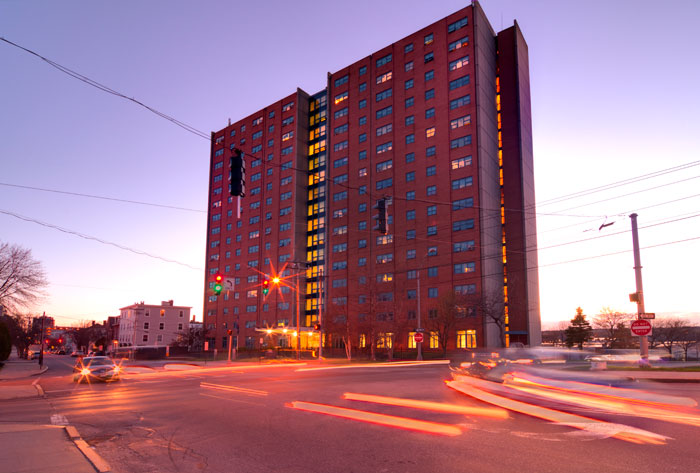
I recently joined the board of the Portland Housing Authority, so this story immediately brought to mind another very similar building we have right here in Portland. Franklin Towers, on the corner of Cumberland and Franklin, is the tallest building in the city, and home to 200 low-income, elderly or disabled households.

Image from Portland Monthly.

Just like La Tour Bois-le-Prêtre, it is 16 stories tall, was built in the brutalist-modern style of 1960s civic architecture, and is facing serious maintenance issues after more than half a century in service. The city will soon have to decide whether to spend millions of dollars renovating Franklin Towers, or nearly as much money to tear it down and leave hundreds of the city's most vulnerable residents scrambling for a place to live.

Franklin Street is going to go through some major changes in the coming years. So what if we did something similar to Franklin Towers? Inspired by La Tour Bois-le-Prêtre, here's my idea:

  • Build a new mixed-use podium building on what is currently the front lawn of Franklin Towers. The ground floor could be leased as retail space, which would provide additional conveniences for residents, while the second floor could hold an additional 10-12 new senior housing apartments.
  • Consolidate the parking area in the back of the building (which currently gobbles up 2/3 of the site), and use the leftover space to build 7 new triple-decker townhouses along Franklin Street, each with 2 studio apartments for seniors on the handicapped-accessible ground level, and 2 family-sized mixed-income apartments on the upper levels, for 28 new units in all.
  • Renovate the existing tower extensively, focusing on energy-efficient improvements.
  • Get the money to finance all these improvements by leasing the top three floors of apartments at market rates as luxury housing. The upper floors have some of the best views in the city, and people will be willing to pay to enjoy them; the displaced residents will be rewarded with brand-new apartments in the new construction outlined above. This measure would help fund more housing on the site while also transforming Franklin Towers into a more egalitarian, mixed-income community.

Here's a sketch of what it might look like:


Wednesday, January 18, 2012

Portland's Smart-Growth Housing Plan: 10 Year Progress Report

Ten years ago, the City of Portland drafted a new Housing Plan. Recognizing that housing prices were rising out of control and that it was becoming increasingly hard to find a place to live here, the city set out to find ways to increase the number of homes and apartments available here.

The city's housing plan is a crucial smart growth strategy for the entire Greater Portland region. Sprawl isn't merely the fault of outlying rural communities. If people are going to be able to live near the places where they work, drive less, and promote local small businesses in walkable neighborhoods, then the City of Portland absolutely needs to provide more housing opportunities in town. Otherwise, households will be forced by basic financial necessity to find affordable housing elsewhere.

So, after ten years, how are we doing? Not so well, as I outline in my column this week in the Portland Daily Sun. In spite of some minor regulatory improvements, the vast majority of the county's new housing is still being built outside of the city limits, in outlying communities. That means more traffic on local streets, more money being spent on foreign oil, fewer customers for local small businesses, and more regional vulnerability to volatile housing markets.

In this blog post, I'll go into some more detail, looking at three specific Housing Plan goals and how we've so far failed to meet them.

Goal: Encourage growth in Portland; target Portland to achieve and maintain a 25% share of Cumberland County's population.

Reality: In 1960, before urban renewal laid waste to our downtown, 40% of Cumberland County residents lived in the City of Portland. In the 2000 Census, 24.2% of the County's population lived in Portland. By the 2010 Census, it was evident that sprawl had continued unabated for the past decade: Portland's population had grown somewhat, but not as fast as the rest of the county. The city now possesses only 23.5% of the county's population, and only 24.4% of the County's housing units:


Cumberland County populationPortland City population% of County population living in PortlandCumberland County Housing UnitsPortland Housing Units% of County housing in Portland
2000265,61264,24924.19%122,60031,86225.99%
2010281,67466,19423.50%138,65733,83624.40%

This goal drives many of the plan's other objectives: if more and more County residents are living farther away, that creates sprawl, and hollows out the city's local economy. Therefore, the City of Portland needs to add new housing within the city's limits, at an equal or greater pace as the rest of the County's municipalities.

The Census Bureau also tracks building permit data for each year, and from those statistics, it's clear that the City isn't even close to keeping pace with sprawl:

Here's the source data, and a link to the Census site.

In this chart, the red line indicates county-wide housing construction for each year since 2000. The orange line is 50% of the height of the red line: that's where the City's housing construction would need to be in order for Portland's population growth to keep pace with the rest of the county's, in line with the housing plan's goals. The blue line, nowhere near the orange line, shows how much housing actually got built each year.

Instead of providing 50% of the County's new homes, the City of Portland has actually built a pathetic 11% of the county's homes. In other words: in the decade since the city's new housing plan got written, roughly 9 out of 10 new homes in Cumberland County have contributed to sprawl. Ugh.

Outlook: You might suppose, as I did, that the City might have had a rebound relative to the rest of the county after 2008, when spiking gas prices and the foreclosure crisis put the big hurt on sprawl development in the suburbs.

Unfortunately, you'd be mistaken: in the past 3 years, the City's proportion of housing construction relative to the rest of the County has fallen even more, to around 6%. The fundamental issue seems to be that new housing construction in Portland is a lot more expensive than it is in the 'burbs, thanks to more expensive real estate and zoning mandates. The main expense that's under the city's control - its outrageously expensive and outdated parking mandates - was loosened somewhat in 2008, when planners reduced off-street parking requirements somewhat. In hindsight, unfortunately, it hasn't had much of an effect, and planners ought to be asking whether they should be doing more.


Goal: Create 300 new units of housing in Bayside within 5 years [by 2007] and 500 additional units within 25 years, a significant portion of which will be owner-occupied units.

Reality: Cumberland County's Census Tract 6 is roughly contiguous with the Bayside neighborhood. Census data indicates that there were 1,421 housing units in the neighborhood in 2000. By the 2010 Census, there were 1,618 housing units: a net gain of 197 homes.

Census Tract 6 extends only as far south as Cumberland Avenue, which means that these numbers don't include the Chestnut St. Lofts project near Portland High School, completed in 2007. Adding that project in bring brings the neighborhood's total to 234 new homes. So five years past the original deadline, the City still hasn't met the plan's short-term goal.

Outlook: Still, two large apartment complexes from Avesta Housing are currently under construction in Bayside, and will add 91 new subsidized apartments within the next year or so. And the Federated Companies, new owners of the Somerset Street blocks along the Bayside Trail, are tentatively planning 540 additional market-rate apartments in high rises on their land. Along with infill projects happening elsewhere in the neighborhood (including, hopefully, along the new Franklin Street), it seems like the city should be able to meet its 25-year housing goal for Bayside, even if it missed the shorter-term goal by a wide margin.


Goal: Encourage and support the Portland Housing Authority to become more active in development of more housing.

Reality: The Portland Housing Authority hasn't developed a single new home on any of its properties since the Reagan administration. But at least there's plenty of free parking in East Bayside!

Outlook: The PHA owns acres of empty and under-utilized real estate on the Portland peninsula and in close-in neighborhoods like East Deering. In the past decade, the value of that land has increased dramatically, and the PHA also possesses the ability to raise capital through bonds. It's in an ideal position, in other words, to de-stigmatize its run-down public housing complexes, improve its financial standing, and help address the city's housing shortages with new, mixed-income housing complexes.

Unfortunately, the PHA is run by bureaucrats whose timidity and lack of creativity and courage are extreme even by bureaucratic standards. I worked with the agency's director, Mark Adelson, during the Peninsula Transit Study, and he insisted that empty parking lots were more important than building new homes for the homeless.

To be fair, the man isn't so much callous as he is afraid that he might hear a complaint from someone who loses their parking lot. 'Tis better for hundreds of people to sleep on the streets than for a single car in East Bayside to park on the street (somebody translate that into Latin so it can be the Agency's new motto).

As a quasi-independent agency, the PHA doesn't have much oversight from the City Council, which is part of the problem. Still, my guess is that the new Mayor and city manager could find creative ways into getting the PHA to be more involved in addressing the city's housing shortages – putting more conditions on the PHA's Community Development Block Grant applications would be a good first step.

Monday, December 5, 2011

Parking Isn't "Affordable"


Two weeks ago, I wrote in my column in the Portland Daily Sun about the obscene expenses for parking garages that our city's planners impose on new publicly-subsidized housing construction:

Joe Lewis’s Planning Board, which approves and denies new construction projects, requires every new home and apartment built in our city to also build one parking space. Want to build a triple-decker on Munjoy Hill? You’ll need to make it a quadruple-decker for a three-car garage on the bottom floor. Want to build studio apartments for college students? They probably don’t drive, but you’ll still be forced to build a parking lot that’s bigger than the building itself.

The parking requirement is particularly onerous for builders who would like to build smaller, less expensive apartments, since it requires them to set aside nearly as much real estate for automobile storage (whether or not it's needed) as they do for rentable living space.

That’s the major reason why the nearly every new apartment building constructed here in the past decade has either required public subsidies, or been targeted and priced for the wealthy. The Planning Board’s obsession with building free parking literally makes it illegal for a private-sector builder to create affordable homes for the city’s thousands of non-motorist households.

Community Housing of Maine, a local nonprofit, is currently trying to finance a project on High Street with 38 apartments, at a cost of about $10 million. The high cost has turned the project and its state financiers into a political talking point for the right wing.

It's a worthy project that would add valuable homes for Portland's downtown workforce. And a number of the project's big-ticket expenses - the in-town real estate, the historic preservation elements - can be justified as things that advance the public good.

But the project's $500,000 underground parking garage unambiguously works against the public interest. Aside from jeopardizing the project's financial viability, the parking garage, if built, would only add more traffic and pollution to Portland streets, and decrease the amount of real estate available for the hundreds of car-free households that need affordable housing more than they need affordable parking.

The High Street project is within walking distance of thousands of downtown jobs and every single one of the region's bus routes. Instead of being forced to spend half a million dollars on a parking garage, affordable housing agencies should be spending their money on housing.

While I'm on the subject of expensive affordable housing, I'd also like to highlight this innovative social housing project built in Chile. Residents of a former slum were given new homes on the same site. Crucially, the architects approached the project "as an investment and not as an expense... to add value over time."

Designers from ELEMENTAL designed 100 no-frills townhomes to be built at dirt-cheap prices:


...but crucially, the design included voids between each home, each of which was intended for future home expansion to be funded and built by the residents themselves. Thus, the design actively encouraged residents to provide their own investments into their homes and neighborhood:


And thus, the residents themselves took the financial responsibility (and rewards) of adding new housing space to their homes, and of adding architectural variety to their neighborhood. The project didn't merely produce affordable housing: it provided a platform for low-income families to build financial equity.

Is this feasible in the USA, with our building codes and housing bureaucracies? It certainly ought to be.


Images courtesy of ELEMENTAL via archdaily.com.

Monday, November 29, 2010

Portland 101 - the housing authority

Last month, I joined a handful of Portland 101 workshops under the auspices of the League of Young Voters, to learn more about how Portland's various government agencies work (read my introductory post here). I learned that relatively little of our "local government" is controlled at City Hall: much of it, from our garbage disposal to our city buses to our drinking water supply, is operated by independent public agencies that operate largely outside of the City Council's control.

In an ongoing series, here's my take on how one of those agencies works, and how those operations impact Portland's built environment.


The Portland Housing Authority is one of the city's largest property owners. It manages over 1000 units of public housing scattered across 62 acres, but its large, monolithic housing complexes dominate several neighborhoods, including parts of the West End, East Deering, and my own neighborhood of East Bayside. It also runs low-income homeownership programs, distributes rent subsidies for renters living in privately-owned apartments, and coordinates some social services in its housing complexes.

The Authority is governed by a seven-person Board of Commissioners who are appointed by members of the City Council for longish 5-year terms. However, the PHA seems to receive most of its funding from the federal Department of Housing and Urban Development (to confirm this, I've put in several unanswered requests for the Authority's financial statements, which - red flag - aren't available on its website). As a result, the City Council seems content to let the PHA run more or less on auto-pilot.

For the most part, I'd say that the PHA seems pretty well-run. But I also see some glaring opportunities for improvement, starting with trying to integrate the PHA's public housing complexes more elegantly into their surrounding neighborhoods, to try and remove the isolation and stigma that everyone (including the PHA's own residents) associates with public housing.

The PHA's properties were generally built during the urban renewal period of the 1960s and 1970s - and they look that way. They also give over way too much real estate to little-used parking lots, which could be sold and put to better use as development sites for new housing, while also contributing to the city's tax revenue.

One PHA parking lot located one block away from my house, on the corner of Oxford and Boyd in East Bayside, typically has five or six cars scattered about its spacious quarter-acre lot - and most of those seem to be owned by renters in the privately-owned apartment building next door. Thus, the PHA is maintaining a mostly-empty parking lot, primarily for the benefit of the private landlord next door, on a plot of land that could easily support walkable, in-town housing for a dozen or more families:


View Larger Map

This is more than a lost opportunity for a city that needs housing more than it needs parking. These parking lots also blight the neighborhood. It's the kind of no-man's land that makes most outsiders afraid to venture into Kennedy Park. If you replaced this empty pavement with families and front porches, then the neighborhood would feel considerably safer, more welcoming, and vibrant.

Regrettably, this is only one example of many - the PHA owns and maintains seven comparably large parking lots in the East Bayside alone, in addition to many, many more elsewhere in the city. Selling just a few of these lots could provide the agency with enough funds to revitalize some of its most problematic properties, give developers the chance to provide more family housing on the free market, lend more dignity to public housing in Portland, and add thousands of dollars in new revenue to the City's tax base.

But as long as PHA is on the federal funding gravy train, with little oversight from City Hall, they'll have little incentive to put their vacant land holdings to their highest and best uses. Obviously, that's something that should change.